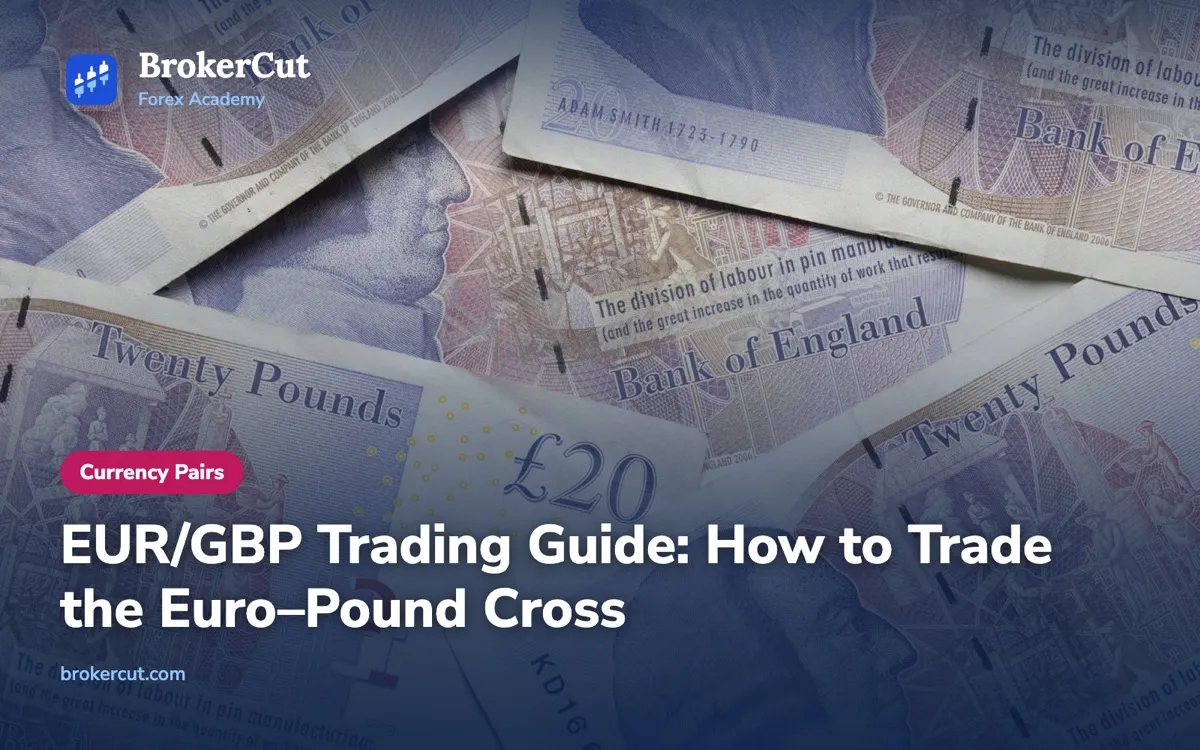
EUR/GBP Trading Guide: How to Trade the Euro–Pound Cross
EUR/GBP trading explained: how the euro–pound cross is priced from two dollar pairs, its pip value in pounds, what moves it and why it ranges.

Open a chart of EUR/GBP next to EUR/USD and GBP/USD and it can look as if nothing is happening: the two dollar pairs swing, and the cross barely stirs. That calm has causes, and EUR/GBP trading goes better once you know them. The dollar drops out of the price, the pip is counted in pounds, and two neighbouring central banks do most of the steering.
Quick answer: EUR/GBP is the price of one euro in pounds. It is a cross pair, so the US dollar drops out, and it usually moves less than EUR/USD or GBP/USD because shocks often hit both economies at once. It moves on the gap between ECB and Bank of England policy, and one pip is worth £10 per standard lot.
What is EUR/GBP? The euro–pound cross explained
EUR/GBP is the exchange rate between the euro and the British pound. The euro is the base currency, the thing being priced, and the pound is the quote currency, the unit the price is written in. A price of 0.8543 means one euro costs about 85 pence. When the number rises, the euro is gaining on the pound; when it falls, the pound is gaining on the euro.
Because the price is below 1, people sometimes read it the wrong way round: one euro buys 0.85 pounds, so one pound buys about 1.17 euros. Brokers quote EUR/GBP, not GBP/EUR, so a view that the pound will strengthen is a sell of EUR/GBP. If that feels backwards, our guide to base and quote currencies and the Academy lesson on currency pairs and quotes both walk through it.
Tap the parts of the quote below to see how each piece of a EUR/GBP price is read.
GBP is the quote currency. The price says how much GBP one EUR costs. Profits and losses are counted in GBP first.
Anatomy of a EUR/GBP quote. The euro is the base currency, the pound is the quote currency, so the price says how many pounds one euro costs and profits land in pounds first.
EUR/GBP is a cross: a pair that does not contain the US dollar. The majors, such as EUR/USD and GBP/USD, all have the dollar on one side. Crosses pair two other currencies directly. You will occasionally hear EUR/GBP called the “chunnel”, after the Channel Tunnel, though the nickname is far less common than cable for GBP/USD. Our guide to major, minor and exotic currency pairs explains where crosses sit in the wider family.
What makes this cross unusual is how closely its two economies are tied. The European Union is the UK’s largest trading partner, the two share neighbouring time zones, and they face many of the same forces, from European energy prices to the broad business cycle. EUR/GBP is a running score of how two close neighbours are doing relative to each other, and that idea explains most of how it behaves.

How EUR/GBP is priced: the cross rate from EUR/USD and GBP/USD
Most currency trading involves the dollar, so the two dollar pairs are the deepest markets either currency has, and they show where the EUR/GBP price comes from. Divide one by the other:
EUR/GBP = EUR/USD ÷ GBP/USD
With EUR/USD at 1.0850 and GBP/USD at 1.2700, that is 1.0850 ÷ 1.2700 = 0.8543. The units show why it works. EUR/USD is dollars per euro. GBP/USD is dollars per pound. Divide one by the other and the dollars cancel, leaving pounds per euro, which is exactly what EUR/GBP measures.
EUR/GBP also trades directly between banks, so your broker is not literally dividing two numbers every tick. But the routes have to agree: if the direct price drifted from the one implied by the dollar pairs, dealers would buy through the cheaper route and sell through the dearer one until the gap closed. That arbitrage keeps the three prices locked together.
The arithmetic is worth knowing because it tells you what the cross will do when the dollar pairs move. Here are four snapshots:
| EUR/USD | GBP/USD | EUR/GBP | What happened |
|---|---|---|---|
| 1.0850 | 1.2700 | 0.8543 | Starting point |
| 1.0900 | 1.2758 | 0.8544 | Dollar weakens against both; the cross barely moves |
| 1.0900 | 1.2700 | 0.8583 | Euro gains on its own; the cross rises 40 pips |
| 1.0850 | 1.2600 | 0.8611 | Pound falls on its own; the cross rises 68 pips |
EUR/USD rose 50 pips and GBP/USD rose 58 pips, yet EUR/GBP moved by a single pip, because both legs rose by almost the same percentage. Whenever the news is really about the dollar, the cross tends to sit still. It only moves when the euro and the pound part company.
EUR/GBP pip value: why a pip is worth £10, not $10
A pip on EUR/GBP is the fourth decimal place, 0.0001, just as on EUR/USD. A move from 0.8543 to 0.8583 is 40 pips. What changes is the currency the pip is counted in. Profit and loss on any pair are calculated in the quote currency first, and here the quote currency is the pound. So on a standard lot of 100,000 euros, each pip is worth 0.0001 × 100,000 = £10.
Unless your account is in pounds, your broker then converts that amount into your account currency at the current rate:
| Lot size | Pip value in pounds | Dollar account (GBP/USD 1.2700) | Euro account (EUR/GBP 0.8543) |
|---|---|---|---|
| Standard (100,000) | £10 | $12.70 | €11.71 |
| Mini (10,000) | £1 | $1.27 | €1.17 |
| Micro (1,000) | £0.10 | about $0.13 | about €0.12 |
Two consequences follow. First, the dollar value of a EUR/GBP pip is not fixed. It rises and falls with GBP/USD: at 1.2500 a standard-lot pip is worth $12.50, at 1.3000 it is $13.00. Second, anyone who sizes EUR/GBP as if a pip were worth $10, the habit most traders pick up on EUR/USD, opens a position about 27% bigger than they meant to, because $12.70 is 27% more than $10. Our guide to what a pip is in forex covers the conversion for every type of pair, and the lesson on pips and lots explains the lot sizes themselves.
One subtlety: because EUR/GBP is priced near 0.85 rather than 1.08, each pip is a bigger slice of the price. A 50-pip move is about 0.59% on EUR/GBP but about 0.46% on EUR/USD, so compare percentages as well as pip counts.
Why EUR/GBP moves less than the dollar pairs
Traders describe EUR/GBP as slower, narrower and more inclined to drift sideways. Those are tendencies rather than rules, but they have clear causes.
The dollar cancels. A large share of what moves EUR/USD and GBP/USD on any given day is news about the dollar: US jobs and inflation data, the Federal Reserve, global demand for dollars as a safe haven. As the table above showed, dollar news lifts or drops both legs together and mostly washes out of the cross. Remove the busiest driver in the market and what is left tends to be calmer.
Shared shocks. Because the UK and the euro area trade so heavily with each other and face many of the same costs, a shock to one often lands on the other too. A jump in European gas prices, a slowdown in global trade or a wave of risk aversion usually hits both economies, and once again the cross only reflects the difference in how hard each is hit.
Policies that often move together. The European Central Bank and the Bank of England frequently move rates in the same direction over a cycle, even if not at the same meetings or by the same amounts. Since EUR/GBP responds to the gap between them, two banks moving in step leave the pair with less to price.
The result is a pair whose daily range, the distance from the day’s high to its low, has usually been the smallest of the three in pips, and which has spent long stretches drifting sideways between familiar levels. That habit is why EUR/GBP is the textbook example in our guide to range trading in forex. EUR/USD and GBP/USD usually show a strong positive correlation; EUR/GBP is, in effect, the part of their movement they do not share. Our guide to currency correlation explains how to read those relationships.
| Feature | EUR/USD | GBP/USD | EUR/GBP |
|---|---|---|---|
| Type | Major | Major | Cross |
| Quote currency | US dollar | US dollar | Pound |
| Pip per standard lot (dollar account) | $10 | $10 | about $12.70 |
| Typical daily movement | Moderate | Wider | Usually the narrowest |
| Policy pairing that matters most | ECB vs Fed | BoE vs Fed | ECB vs BoE |
| Most active hours (UK time) | London and the NY overlap | London open and the NY overlap | The London session |
Big moves on EUR/GBP
A pair that usually moves less can still move a great deal when the two neighbours are hit differently. In the 2008 financial crisis, the pound fell so sharply that EUR/GBP climbed close to parity by the end of the year. On the night of the UK’s EU referendum in June 2016, the pound dropped steeply against the euro as results came in, and the cross kept climbing for months afterwards. Such moves are rare, but they catch out anyone who treats EUR/GBP as sleepy. The comparison guides for EUR/USD trading and GBP/USD trading are useful side-by-side reading.
What moves EUR/GBP: ECB versus Bank of England
Over weeks and months, the strongest current under EUR/GBP is the relationship between interest rates in the euro area and the UK. Each central bank sets a policy interest rate, and money tends to flow towards the currency whose rates are higher, or expected to rise further. Step through the chain below for one bank, then switch it to a cut.
How one central bank's rate decision reaches its currency: rates, yields, capital flows, demand, price. On EUR/GBP the same chain runs for the ECB and the Bank of England at once, and the cross follows whichever pushes harder.
On EUR/GBP you compare two European banks with similar mandates, so the cross is sensitive to relative surprises. A hawkish Bank of England helps the pound and pushes EUR/GBP down; a hawkish ECB helps the euro and pushes it up. What the pair tracks is the expected gap between the two, and above all, changes in that expectation.
The two central banks
The European Central Bank sets policy for every country that uses the euro. Its Governing Council meets on monetary policy eight times a year, targets inflation of 2% over the medium term, and announces its decision at 13:15 UK time, followed by a press conference at 13:45 that often matters more than the decision itself.
The Bank of England’s nine-member Monetary Policy Committee also meets eight times a year and targets 2% inflation. It publishes its decision, minutes and each member’s vote at 12:00 UK time. The vote split is often what moves the pound: a hold where more members than expected voted for a cut can weaken sterling almost as much as a cut. Because decisions are signalled well in advance, the expected outcome is usually priced in by meeting day, and EUR/GBP reacts to the part that is more hawkish or dovish than forecast. Our guide on how interest rates affect currency prices and the Academy lesson on central banks and interest rates cover the full chain.
UK data at 07:00
The Office for National Statistics publishes its market-moving releases at 07:00 UK time: consumer prices (CPI), the labour market report with its closely watched wage figures, and monthly GDP. A surprise can move EUR/GBP sharply in thin early trading, and inflation and wages tend to matter most because they feed straight into Bank of England expectations.
Euro area data in the morning
On the euro side, the headline releases are the flash inflation estimate (HICP) from Eurostat, around the turn of each month at about 10:00 UK time, and the flash business surveys known as PMIs, around the third week of the month at about 09:00 UK time, with the UK’s own PMIs shortly after. German inflation figures a day or two earlier often give a hint.
Politics, and what matters less
Anything that changes the relationship between the two neighbours can move the cross: trade negotiations, elections on either side, and UK budgets that change how investors view British public finances. Treat scheduled political events like high-impact data. US releases, by contrast, move both legs at once, so on a typical US data day EUR/GBP is usually the quietest of the three, unless a global scare hits the pound and the euro differently.
When to trade EUR/GBP: the London session
The forex market is open around the clock on weekdays, but EUR/GBP keeps European office hours. Both of its home economies are in Europe, its key data comes out in the European morning, and both central banks announce in the middle of the London day. The clock below converts the four main trading sessions into your local time.

Open now: …
The four forex sessions in your local time. EUR/GBP does most of its moving in the London session, when both of its home markets are trading; the late US and Asian hours are usually thin.
In UK time, a typical EUR/GBP day looks like this:
- Asian hours (about 23:00–07:00): usually very quiet, with wider spreads.
- 07:00 UK data: inflation, jobs and GDP figures can jolt the cross before London is fully open.
- London morning (about 08:00–12:00): the busiest stretch, with euro area data and deep liquidity.
- 12:00 and 13:15 on meeting days: Bank of England and ECB decisions.
- Afternoon to the London close (about 16:30): still active, then the cross often drifts until the next morning.
Our guide to forex market hours and the lesson on market sessions cover time zones and clock changes in detail.
Timing matters more on this pair than most, because of cost. The spread, the gap between the bid and the ask, is usually a little wider on EUR/GBP than on EUR/USD, since fewer participants quote it. On a pair that covers fewer pips in a day, that cost is a bigger share of what you can hope to make: 1.5 pips is small on a 100-pip day and meaningful on a 30-pip day. Our guide to forex trading costs and the lesson on the bid–ask spread explain how to measure it.
EUR/GBP trading: how to trade the cross
Read the policy regime first. When markets expect the ECB and the Bank of England to move on similar paths, the cross has little to price and tends to drift sideways, and range methods, buying near support and selling near resistance, often suit it. When the expected paths diverge, the pair can break out and trend for weeks. The skill is noticing which regime you are in and switching method when it changes.
Respect a regime change. The chart below shows the second case. Step through it to see a quiet range end with a Bank of England surprise, and how a trade might be planned on the retest.
An illustrative EUR/GBP four-hour chart: a quiet range, a dovish Bank of England surprise that breaks it, then a buy plan on the retest of the old ceiling. Prices are illustrative, not market data.
That pattern, a breakout followed by a retest of the old edge, is covered in our guide to breakout trading. Here the trigger gives it weight: the market has a new reason to reprice the gap between two central banks.
Size from the stop and the pound pip value. Smaller daily ranges usually mean tighter stops in pips, and tighter stops mean bigger positions for the same risk. That is fine, as long as you use the right pip value. Fix the money you are willing to lose, your risk per trade, then work out the position size that loses exactly that if the stop loss is hit. Try it in the calculator below: enter your balance and stop, and change the pip value from 10 to 12.70 for a dollar account.
The chart set the stop, the stop and the pound pip value set the size, and the structure set the target. Leverage magnifies losses as well as gains, and a majority of retail accounts trading leveraged currency products lose money, so the sizing step is the one never to skip. Our guide to position sizing in forex and the lesson on position sizing cover the method in full.
Count your currency exposure. Buying EUR/GBP while selling GBP/USD is two bets against the pound; buying EUR/GBP and EUR/USD is two bets on the euro. One surprise can hit both. The Academy lesson on correlations shows how to add up exposure across pairs.
Check the overnight cost. Positions held past the daily rollover are credited or charged swap, which mostly reflects the euro–pound interest-rate gap and adds up over weeks. Our guide to swap in forex explains how it is calculated.
Common mistakes when trading EUR/GBP
Sizing with $10 a pip
On a dollar account a EUR/GBP pip is worth about $12.70 per standard lot, so carrying over the $10 habit from EUR/USD makes every position about 27% larger than planned. Enter the correct pip value every time.
Reading dollar news into the cross
A strong US jobs report can send both dollar pairs tumbling while EUR/GBP barely moves. If your reason for the trade is really a view on the dollar, you are trading the wrong pair.
Taking a quiet pair for a safe one
Narrow ranges tempt traders into big positions and tight stops, until a surprise vote moves the cross several times its normal distance in an hour. Stay small or flat into central bank days and the 07:00 UK releases.
Ignoring the spread on a small range
A spread that is trivial on a fast pair can eat a large share of a 20-pip target on EUR/GBP. Compare it with your stop and target, and avoid the thin hours.
Assuming the range will last for ever
The sideways habit is a tendency, not a law. When one bank’s outlook shifts, the old range can break and stay broken. Note how your ranges ended in a trading journal to see whether you are slow to accept a break.
Frequently asked questions
How is EUR/GBP calculated?
EUR/GBP can be worked out by dividing EUR/USD by GBP/USD. With EUR/USD at 1.0850 and GBP/USD at 1.2700, that gives 1.0850 ÷ 1.2700 = 0.8543. The dollar cancels out, leaving pounds per euro. The pair also trades directly, but arbitrage keeps the direct price in line with this cross rate.
How much is 1 pip worth on EUR/GBP?
Because the pound is the quote currency, one pip on a standard lot of 100,000 euros is worth £10, a mini lot £1 and a micro lot 10p. For a dollar account that is converted at GBP/USD, so about $12.70 at 1.2700. For a euro account it is about €11.71 at EUR/GBP 0.8543.
Why does EUR/GBP move so little?
Dollar news, which drives much of the daily movement in EUR/USD and GBP/USD, mostly cancels out of the cross. The UK and euro area economies are also closely linked, face many of the same shocks, and often see their central banks move in the same direction. The cross only moves when the two diverge.
What moves EUR/GBP the most?
Over time, the expected gap between Bank of England and ECB interest rates matters most. Day to day, the biggest moves usually come from surprises in UK inflation and wage data, euro area inflation and business surveys, central bank decisions and votes, and political events that affect one side more than the other.
When is EUR/GBP most active?
EUR/GBP is usually most active during the London session, roughly 07:00 to 16:30 UK time, when UK data, euro area data and both central bank decisions are released. It tends to be quiet in Asian hours and after the London close, when spreads are usually wider.
Is EUR/GBP good for beginners?
It can suit beginners who want a calmer pair, provided they use the correct pip value in pounds and respect costs. Spreads are usually a little wider than on EUR/USD, and quiet spells can end abruptly on central bank days, so practise on a demo account first.
Free course
Learn this step by step
“Forex Foundations” is a free BrokerCut Academy course: 11 short lessons (about 92 minutes), quizzes, interactive tools and a certificate when you finish.
Enrol free