Base Currency vs Quote Currency: How to Read Any Forex Pair
Base currency vs quote currency explained: how to read any forex pair, what buying it means, which currency your profit is in and why pairs are ordered.

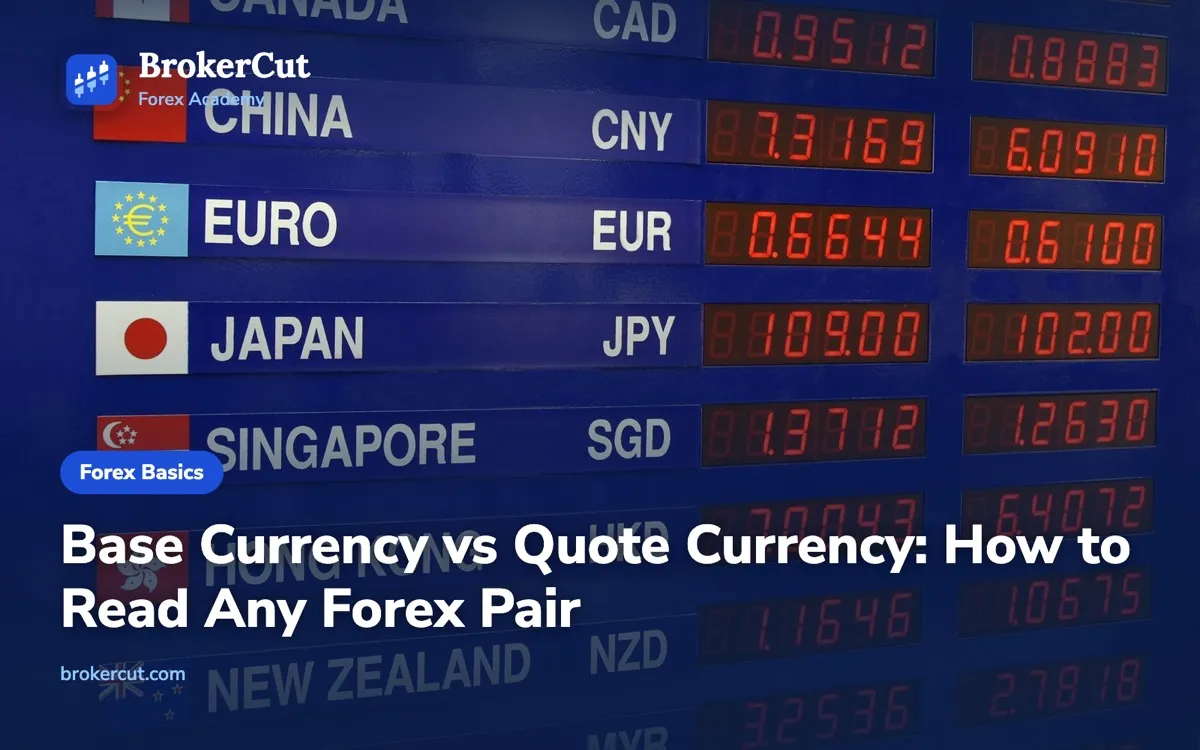
EUR/USD 1.0850. USD/JPY 150.00. GBP/USD 1.2700. Every forex price is written as two currencies and a number, and if you are not sure which currency the number describes, you cannot tell whether a trade made or lost money, or even which way you are betting.
Quick answer: In a forex pair, the base currency is the first and the quote currency is the second. The price is how much of the quote currency buys one unit of the base: EUR/USD at 1.0850 means one euro costs 1.0850 dollars. Buying the pair buys the base and sells the quote; profit is counted in the quote currency.
What are the base currency and quote currency?
A currency has no price on its own. A euro is only “worth” something when you compare it with another currency, so forex prices always come in pairs. The pair names the two currencies, and the order they are written in carries meaning.
- The base currency is the first currency in the pair. It is the thing being priced, and the price always refers to one unit of it.
- The quote currency is the second currency. It is the money the price is expressed in, the measuring stick.
So in EUR/USD, the euro is the base and the US dollar is the quote. In USD/JPY, the dollar is the base and the Japanese yen is the quote. The same currency can be the base in one pair and the quote in another: the dollar is the quote in EUR/USD and the base in USD/JPY. Its role depends entirely on where it sits. Tap the parts of the quote below to see each one labelled.
EUR is the base currency: the one you are buying or selling. The price is always for one unit of it.
In EUR/USD the euro is the base currency, the thing being priced, and the US dollar is the quote currency the price is written in. The two numbers are the bid and the ask.
The three-letter codes are not invented by brokers. They come from the international standard ISO 4217, which gives every currency a code: usually the first two letters name the country and the third names the currency, so USD is the United States dollar and JPY the Japanese yen. The euro, which belongs to no single country, is EUR. You will see the pair written with a slash (EUR/USD), without one (EURUSD), or with a dot or dash, depending on the platform. The order never changes, and the order is what matters.
You already read prices this way every day. “Petrol is 1.45 a litre” prices one litre in pounds. A currency pair does the same job, except that the thing being priced is itself money.
That is also how official exchange rates are published. The European Central Bank’s euro reference rates list how many units of each foreign currency one euro buys, which makes the euro the base currency in every rate on the page. Once you know which side is the base, any table of rates becomes readable.
How to read a currency pair: the one-unit rule
The price is how much of the second currency you need to buy one unit of the first.
Apply it to the three most familiar pairs and you can read each one aloud in plain English.
- EUR/USD 1.0850: one euro costs 1.0850 US dollars.
- USD/JPY 150.00: one US dollar costs 150 Japanese yen.
- GBP/USD 1.2700: one British pound costs 1.27 US dollars.
The size of the number tells you nothing about which currency is “stronger” in any useful sense. USD/JPY sits around 150 because one yen is a small unit of money, not because the dollar is 150 times better. EUR/USD sits near 1 because a euro and a dollar are similar-sized units. What matters to a trader is the direction the number moves, and the rule tells you what each direction means:
- The number rises: one unit of the base buys more of the quote. The base has strengthened against the quote, or the quote has weakened against the base.
- The number falls: one unit of the base buys less of the quote. The base has weakened, or the quote has strengthened.
A pair is a ratio between two currencies, so you can never tell from the pair alone which side did the moving. If EUR/USD rises from 1.0850 to 1.0900, the euro may have strengthened, the dollar may have weakened, or both may have happened at once. The number only records the relationship. That is why traders look at the same currency across several pairs before deciding whether “the dollar is strong today” or “the euro is strong today”.
Now try the rule on a pair where the dollar comes first. Here the dollar is the base and the yen is the quote, so the price is in yen.
JPY is the quote currency. The price says how much JPY one USD costs. Profits and losses are counted in JPY first.
In USD/JPY the dollar is the base and the yen is the quote, so the price is how many yen one dollar costs. When the number rises, the dollar is buying more yen.
Our step-by-step guide to how to read a forex quote covers the rest of a live price: the bid, the ask, the pipette and how the platform displays them.
Buying and selling a pair: what really changes hands
Because the price is always for the base currency, every trade is a statement about the base. When you buy a pair you buy the base currency and pay for it with the quote currency. When you sell a pair you sell the base and receive the quote. Two currencies always change hands, in opposite directions.
Traders use the words long and short for this. Buying EUR/USD makes you long the euro and short the dollar. Selling EUR/USD makes you short the euro and long the dollar. You do not need to own euros to sell them: on a retail account, you are trading the price change, and the position is settled in your account currency when you close it. Our guide to long vs short in forex explains why selling first feels strange at the start and why it is completely routine in currencies.
The practical rule is short enough to write on a sticky note:
- Your view on the base currency decides the button. Expect the base to strengthen, buy the pair. Expect it to weaken, sell the pair.
- A view on the quote currency flips it. Expect the quote currency to strengthen, sell the pair. Expect it to weaken, buy.
The second line is where beginners slip, usually on pairs where the dollar comes first. Suppose you expect the Japanese yen to strengthen. The yen is the quote currency in USD/JPY, so a stronger yen means one dollar buys fewer yen and the number falls. To express a bullish view on the yen, you sell USD/JPY. Clicking buy because you “like the yen” puts you on the wrong side of your own idea.
The same logic applies to USD/CHF and USD/CAD. A view that the Swiss franc or the Canadian dollar will rise is a sell of the pair, because both are quote currencies there. Before you place any order, say the trade in full: “I am buying dollars and selling yen” or “I am selling pounds and buying dollars”. If the sentence does not match your view, do not click.
Base sets the size, quote sets the profit
Position size is measured in the base currency. Profit and loss are measured in the quote currency.
When you open one lot of a pair, you are trading a fixed quantity of the base currency. A standard lot is 100,000 units of the base, a mini lot 10,000 and a micro lot 1,000. So one mini lot of GBP/USD is 10,000 pounds, one mini lot of USD/JPY is 10,000 dollars and one mini lot of EUR/GBP is 10,000 euros. The squares below show the three sizes; every square is 1,000 units of whichever currency comes first in the pair.
Lot sizes are counted in the base currency: each square is 1,000 units of the first currency in the pair. A mini lot of GBP/USD is 10,000 pounds; a mini lot of USD/JPY is 10,000 dollars.
The price movement, on the other hand, is written in the quote currency, so the money it produces arrives in the quote currency too. A pip on GBP/USD is 0.0001 dollars per pound. Multiply that by 10,000 pounds and each pip is worth 1 dollar. A pip on USD/JPY is 0.01 yen per dollar. Multiply that by 10,000 dollars and each pip is worth 100 yen, not 100 dollars.
This split also explains margin. Your broker works out the margin on the full value of the position, which for 10,000 pounds of GBP/USD at 1.2700 is $12,700. At 1:30 leverage, that is about $423 of margin, even though each pip is worth only $1. Our guides to lot sizes and to what a pip is go through both halves in more depth, and the Academy lesson on pips and lots has short exercises to practise them.
Which currency is your profit in? Converting to your account currency
Since profit and loss arrive in the quote currency, what happens if your account is in a different currency? Your broker converts the result for you automatically, but you need to understand the conversion to size trades correctly before you open them. There are only three situations, and each has a simple rule.
1. The quote currency is your account currency
This is the easy case. If your account is in US dollars and you trade EUR/USD, GBP/USD or AUD/USD, the result is already in dollars. Buy 10,000 units of EUR/USD at 1.0850, close at 1.0900, and the gain is 0.0050 × 10,000 = $50. Nothing to convert. This is why pip values for “dollar-quoted” pairs are so tidy: $10 per standard lot, $1 per mini lot, 10 cents per micro lot.
2. The base currency is your account currency
Now take a dollar account trading USD/JPY. The result arrives in yen, and you need to turn it into dollars. Because USD/JPY tells you how many yen one dollar costs, you divide the yen figure by the USD/JPY price. A gain of ¥8,000 at a price of 150.80 is 8,000 ÷ 150.80 = about $53.05.
The dollar value of a USD/JPY pip is not fixed. One standard lot earns ¥1,000 per pip. At 150.00 that is about $6.67; at 140.00 it is about $7.14. The same applies to USD/CHF and USD/CAD for a dollar account. Type two USD/JPY prices into the counter below to see the pip count, and note how its value per lot is given at the current price.
The highlighted digit is the pip. For USD/JPY the pip is the second decimal and its dollar value depends on the price.
3. Neither currency is your account currency
On a cross such as EUR/GBP, a dollar account sees the result in pounds. To convert it, you use the exchange rate between the quote currency and your account currency, in this case GBP/USD. Since GBP/USD prices one pound in dollars, you multiply. A gain of £40 with GBP/USD at 1.2700 is 40 × 1.27 = $50.80.
The same three rules work for any account currency. If your account is in pounds and you trade EUR/USD, the result is in dollars, and the pair that links dollars to pounds is GBP/USD. A $50 gain is 50 ÷ 1.2700 = about £39.37. One way to remember it: if your account currency is the base of the conversion pair, divide; if it is the quote, multiply.

Conversion is not a second trade you place; the platform does it when it reports your profit and loss. Because the conversion rate keeps moving, an open position’s value in your account currency can drift slightly even when the pair has not moved, which is why your platform’s figure rarely matches a mental “pips × $10” exactly. Our guides to pip value by pair and how to calculate forex profit work through every combination, and the Academy lesson on position sizing shows how pip value feeds into the size of every trade.
Forex quote conventions: why is it EUR/USD but USD/JPY?
If the base currency is simply whichever comes first, who decided the order? Nobody passed a law. The order of the major pairs is a market convention, settled by long practice among banks so that everybody quotes the same way and nobody has to ask “which way round?”. Broadly, the convention follows a priority list. When two of these currencies form a pair, the one higher on the list is usually the base:
Read along the list and the familiar names fall out: EUR/USD, GBP/USD, AUD/USD and NZD/USD put the dollar second, while USD/CAD, USD/CHF and USD/JPY put it first. Crosses follow the same order: EUR/GBP rather than GBP/EUR, GBP/JPY rather than JPY/GBP, AUD/NZD rather than NZD/AUD.
There are historical reasons for parts of the order. Sterling was the dominant trading currency long before the dollar, and the pound has traditionally been quoted as the base against the dollar; traders still call GBP/USD “cable”, a nickname usually traced to the telegraph cable that carried the rate across the Atlantic. When the euro was launched in 1999, the market placed it first against every other major currency. For the rest, the order is partly practical: quoting a large unit as the base keeps prices in a readable range. JPY/USD would trade around 0.0067, which is awkward to read and to count in pips.
Three cautions keep the convention in perspective:
- It is a convention, not physics. Occasionally a data source shows a pair the other way round, and conventions for less common pairs can vary. Always read the pair as written on your screen.
- Emerging-market currencies usually come second. Against the dollar, pairs such as USD/MXN, USD/ZAR and USD/TRY put the dollar first, so the prices are many units of the local currency per dollar.
- Metals follow their own habit. Gold is quoted as XAU/USD: one troy ounce of gold priced in dollars. The same reading rule applies.
The convention also shapes which pairs are most traded and cheapest to trade. Our guide to major, minor and exotic currency pairs explains how the groups differ in spread and behaviour, and the Bank for International Settlements’ triennial survey is the official source for how much each currency and pair is traded worldwide.
Inverse quotes: flipping a pair with 1 ÷ price
Any pair can be turned around. If one euro costs 1.0850 dollars, then one dollar costs 1 ÷ 1.0850 = 0.9217 euros. That flipped price is called the inverse or reciprocal quote, and it carries exactly the same information, seen from the other side.
A few things follow from this:
- Direction flips. If EUR/USD rises, USD/EUR must fall. Buying EUR/USD is economically the same position as selling USD/EUR.
- Percentages are close but not identical. A rise in EUR/USD from 1.0850 to 1.0950 is about 0.92%. The same move seen as USD/EUR, from 0.9217 to 0.9132, is a fall of about 0.91%. Over small moves the gap is tiny; over very large moves it becomes noticeable.
- Pips do not translate one for one. A 100-pip rise in EUR/USD is not a 100-pip fall in USD/EUR; in this example it is about 85 pips. Pips are counted in the quote currency of whichever version you are looking at, so they change when you flip the pair.
Inverse quotes matter in real life. A travel money service might show “dollars per pound” on one screen and “pounds per dollar” on another, and headlines often describe a move from the home country’s point of view. When the yen is described as falling to a multi-year low, that usually appears on your chart as USD/JPY rising. When you see a rate anywhere, ask the one-unit question: one unit of which currency, priced in what?
The same logic is behind every pip value table, and it is why the Academy lesson on currency pairs and quotes starts with the one-unit rule before anything else. Remember too that you buy at the ask and sell at the bid, so the entry and exit above already sit on the correct side of the bid and ask spread; the Academy lesson on the bid–ask spread explains why a new trade starts slightly negative.
Common mistakes with base and quote currencies
Buying the pair to back the quote currency
The classic error. You expect the Swiss franc or the yen to rise, so you buy USD/CHF or USD/JPY because you “like” the currency. Both are quote currencies there, so your buy order is a bet against your own idea. Say the trade aloud, “buy dollars, sell francs”, before you click.
Assuming every pip is worth $10 a lot
That figure only holds when the dollar is the quote currency and your account is in dollars. On USD/JPY, USD/CAD and USD/CHF, and on every cross, the pip value changes with the exchange rate. Size a USD/JPY trade as if each pip were $10 a lot and, at 150, you risk about a third less than you planned. On EUR/GBP, where a standard-lot pip is £10, or about $12.70, you would risk over a quarter more.
Reading a big number as a strong currency
USD/JPY near 150 and EUR/USD near 1.08 say nothing about which currency is stronger. They reflect the size of each unit. What matters is how the number changes over time.
Ignoring which side moved
When EUR/USD jumps, it is tempting to credit the euro. Often it is the dollar weakening across the board after US data. Check the same currency in two or three other pairs before you build a story about one side.
Treating an inverse quote as a different market
USD/EUR is not a new opportunity; it is EUR/USD turned around. If you ever see both versions, one buy equals the other sell, and trading both just doubles your exposure to one relationship.
Frequently asked questions
What is the difference between the base currency and the quote currency?
The base currency is the first currency in a pair and the quote currency is the second. The price shows how much of the quote currency you need to buy one unit of the base. In EUR/USD at 1.0850, the euro is the base and one euro costs 1.0850 US dollars, the quote currency.
Is the base currency the one you are buying?
Only when you buy the pair. Buying a pair buys the base currency and sells the quote currency. Selling the pair does the opposite: you sell the base and buy the quote. Your view on the base currency decides which button to press: expect it to rise, buy; expect it to fall, sell.
Which currency is profit calculated in, base or quote?
Profit and loss are calculated in the quote currency first, because the price is written in it. Your broker then converts the result into your account currency at the current exchange rate. If the quote currency is already your account currency, as with EUR/USD on a dollar account, no conversion is needed.
Why is it USD/JPY and not JPY/USD?
By market convention. Banks quote the major pairs in a fixed order, roughly EUR, GBP, AUD, NZD, USD, CAD, CHF, JPY, with the higher-ranked currency as the base. Putting the dollar first also keeps the price in a readable range: JPY/USD would be around 0.0067 rather than 150.
How do you calculate an inverse currency quote?
Divide 1 by the price. EUR/USD at 1.0850 becomes USD/EUR at 1 ÷ 1.0850, about 0.9217. The inverse carries the same information from the other side: when the original pair rises, the inverse falls by almost, but not exactly, the same percentage.
Does the base currency affect the size of my trade?
Yes. Lot sizes are measured in the base currency, so one mini lot of GBP/USD is 10,000 pounds and one mini lot of USD/JPY is 10,000 dollars. Margin is worked out on that full amount, while each pip's value is set by the quote currency.
Free course
Learn this step by step
“Forex Foundations” is a free BrokerCut Academy course: 11 short lessons (about 92 minutes), quizzes, interactive tools and a certificate when you finish.
Enrol free