Major, Minor and Exotic Currency Pairs: What's the Difference?
Major, minor and exotic currency pairs explained: what sets each group apart, how spreads, swaps and volatility differ, and which pairs suit beginners.

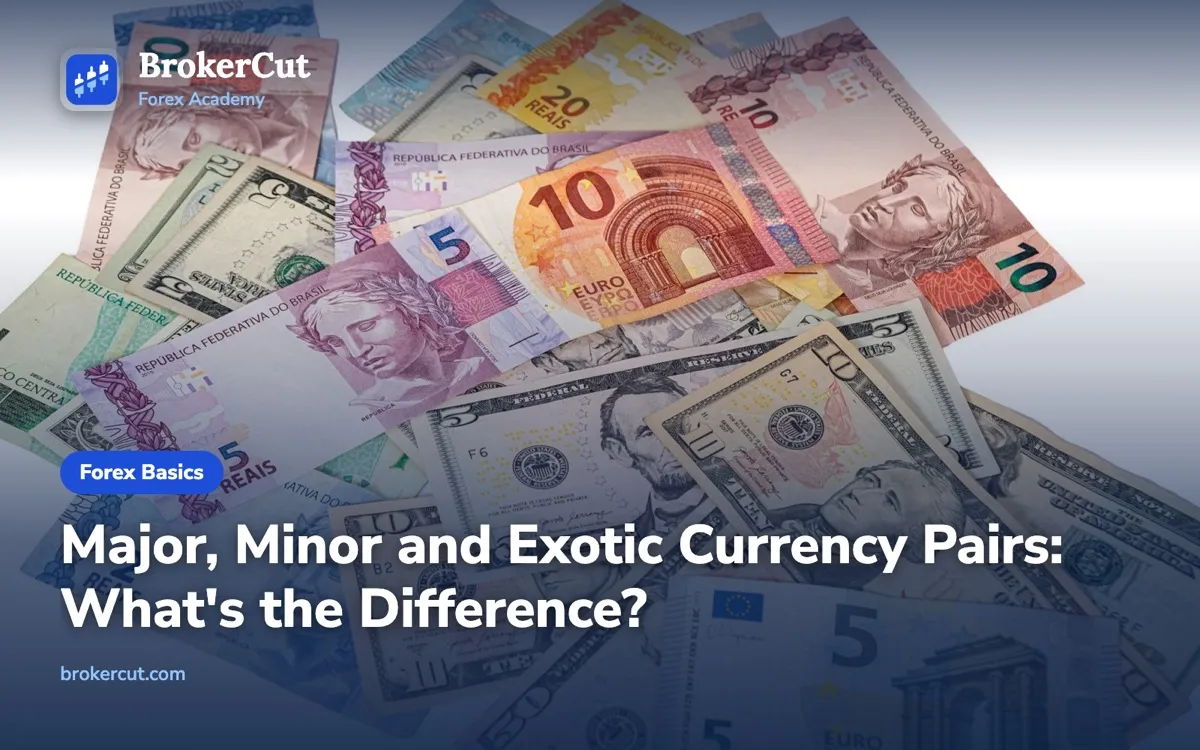
Open any trading platform and you will find dozens of currency pairs, grouped into major, minor and exotic pairs. The labels tell you something practical: how much each pair costs to trade, how far it can move and how easily you can get out.
Quick answer: Major pairs combine the US dollar with one of seven other big currencies, such as EUR/USD. Minor pairs, or crosses, combine two big currencies without the dollar, such as EUR/GBP. Exotic pairs match a big currency with a smaller or emerging-market one, such as USD/ZAR. Liquidity falls and costs rise as you move down that list.
What are major, minor and exotic pairs?
Every forex price compares two currencies. In EUR/USD 1.0850, the euro is the base currency and the dollar is the quote currency: one euro costs 1.0850 dollars. If that idea is new, start with our guide to base and quote currencies and come back.
Traders sort the pairs into three families according to which currencies are involved:
- Major pairs contain the US dollar on one side and one of seven other heavily traded currencies on the other: the euro, Japanese yen, British pound, Swiss franc, Australian dollar, Canadian dollar or New Zealand dollar.
- Minor pairs, also called crosses or cross pairs, combine two of those big currencies without the dollar. EUR/GBP, EUR/JPY and GBP/JPY are the best known.
- Exotic pairs combine one big currency, usually the dollar or the euro, with the currency of a smaller or emerging economy: the South African rand, Mexican peso, Turkish lira, Polish zloty, Singapore dollar and many more.
The boundaries are conventions, not laws, and you will see small disagreements. Some sources list only four majors (EUR/USD, USD/JPY, GBP/USD and USD/CHF) and call the Australian, Canadian and New Zealand dollar pairs commodity pairs, because those economies export a lot of raw materials (see commodity currency). Some use “minor” only for crosses between the euro, pound and yen. And the Scandinavian currencies, such as the Swedish krona and Norwegian krone, are filed as minors on one platform and exotics on another.
What matters is the property the labels stand for: liquidity, the amount of buying and selling going on at any moment. It is what makes a pair cheap and smooth to trade, and it falls steadily from majors to minors to exotics. Our Academy lesson on currency pairs and quotes covers reading any pair; this guide is about choosing between them.
The seven major currency pairs and why the dollar is in all of them
The US dollar is the world’s reserve currency. Commodities such as oil are mostly priced in it, a large share of international trade and debt is invoiced in it, and central banks hold more of it in reserve than any other currency. As a result, the dollar is on one side of close to nine in ten of all currency trades, according to the Bank for International Settlements’ Triennial Survey, the most complete count of global forex turnover.
That is why every major pair contains it. The seven majors, and their market nicknames, are:
| Pair | Nickname | Notes |
|---|---|---|
| EUR/USD | Fiber | The most traded pair in the world |
| USD/JPY | (none widely used) | Usually the second most traded; a pip is the second decimal |
| GBP/USD | Cable | Larger daily swings than EUR/USD |
| USD/CHF | Swissie | The franc is a traditional safe haven |
| AUD/USD | Aussie | Sensitive to commodities, China and global risk mood |
| USD/CAD | Loonie | Often moves with the price of oil |
| NZD/USD | Kiwi | Smallest of the majors, still very liquid |
The dollar is the base currency in some majors (USD/JPY, USD/CHF, USD/CAD) and the quote in others. That convention does not change liquidity, but it changes what your trade means: buying USD/JPY is a bet on the dollar rising; buying EUR/USD is a bet on it falling. Our pair guides on EUR/USD, GBP/USD and USD/JPY go through each major’s drivers in detail.
Because so many participants trade the majors at every hour, they offer the tightest spreads and the most reliable fills, which is why most traders spend most of their time in them. Our guide to the most traded currency pairs looks at the turnover rankings in more detail.
There is one catch. Every major shares the same currency, so the majors tend to move together whenever the dollar itself is moving. Tap the grid below to see how closely, then use the counter to add up your dollar exposure across a few positions.
Typical correlation between pairs
| EUR/USD | GBP/USD | AUD/USD | USD/JPY | USD/CHF | USD/CAD | |
|---|---|---|---|---|---|---|
| EUR/USD | ||||||
| GBP/USD | ||||||
| AUD/USD | ||||||
| USD/JPY | ||||||
| USD/CHF | ||||||
| USD/CAD |
Tap any cell to see what that correlation means for two open positions.
How many times are you really betting on the dollar?
Typical correlations between six major pairs (illustrative, not live data). Pairs with the dollar on the same side tend to move together; pairs with it on opposite sides tend to move in opposite directions. Use the counter to see how three trades can be one dollar bet.
Three trades that each buy a currency against the dollar are mostly one trade on the dollar falling; our guide to currency correlation and the lesson on correlation risk show how to size for it.
Minor currency pairs: how crosses are priced
A minor pair, or cross, lets you trade two big currencies directly against each other without the dollar. If you think the euro will outperform the pound but have no view on the dollar, EUR/GBP expresses exactly that idea. Buying EUR/USD and selling GBP/USD gets you to roughly the same place, but with two spreads to pay and two positions to manage.
Today the popular crosses have their own markets, but the price of any cross is still tied to the two dollar pairs behind it. If the cross drifted away from that implied price, banks would buy one side and sell the other until the gap closed. The diagram shows the arithmetic.
This link explains two things you will notice about minor pairs.
They usually cost a little more. Fewer participants trade a cross directly, so its spread is typically wider than a major’s. For popular crosses such as EUR/GBP and EUR/JPY the difference is modest; for less common ones, such as EUR/NZD or GBP/CAD, it can be noticeably larger, especially outside the main sessions.
They can move more, or less, than either leg. When two currencies tend to move in the same direction against the dollar, as the euro and pound often do, their cross is calm: much of each leg’s movement cancels out. When they tend to move in opposite directions, the moves add up. That is why GBP/JPY is known for large daily ranges: the pound is mildly sensitive to risk appetite while the yen is a safe haven, so in a sell-off one falls as the other rises. Our pair guides on EUR/GBP and GBP/JPY look at both cases.
Crosses are also where the yen’s quirk returns. Any pair quoted in yen, such as EUR/JPY or AUD/JPY, counts its pip at the second decimal place rather than the fourth, and its pip value depends on the yen rate. The lesson on pips and lots shows how to convert it.
Exotic currency pairs: what makes a pair exotic
An exotic pair joins one big currency to the currency of a smaller or emerging economy. These are not obscure currencies: South Africa, Mexico and Poland have large economies. They are “exotic” because far less forex trading happens in them, and because their economies are more exposed to sudden shifts in politics, inflation and capital flows.
The first thing you notice is the price itself. Exotic rates are often large numbers, and their spreads are much wider in pips. The quote below uses illustrative numbers for the dollar against the South African rand.
The spread is the gap between bid and ask: 150 pips here. It is the cost of opening a trade, paid the moment you enter.
An illustrative USD/ZAR quote: one US dollar costs about 18.24 South African rand. The spread is 150 pips, but each pip is worth far less than a EUR/USD pip, so compare costs as a share of the price, not in pips.
The label covers a wide range. Some exotics, such as the Mexican peso, trade actively and fairly smoothly in their busy hours. Others are thin, with spreads that balloon outside their home market’s hours. A few currencies are actively managed by their central banks. The Hong Kong dollar is held within a narrow band of 7.75 to 7.85 per US dollar under the city’s linked exchange rate system, so USD/HKD barely moves until, in principle, the policy changes.
Managed currencies can produce some of the largest single moves in forex, because a peg feels calm right up until it is abandoned. The famous example involves a major, not an exotic: on 15 January 2015 the Swiss National Bank removed the 1.20 floor it had kept under EUR/CHF, and the franc jumped by tens of percent within minutes. Exotic currencies have their own long history of sudden devaluations and capital controls.

Exotics also follow their own clock. Liquidity in a currency is highest when its home market and the big financial centres are open together, and thinnest when its home market is asleep. The rand trades most actively in European hours, the peso during the New York session and the Singapore dollar in Asian hours. The clock below shows the four main sessions in your own time zone.
Open now: …
The four main forex sessions in your local time. Each exotic currency is most liquid while its own region and a major centre are open together, so a rand pair is busiest in London hours and a peso pair in New York hours.
As a rule of thumb, trade any pair, and especially an exotic, when its own market is awake. Our forex market hours guide and the lesson on market sessions explain the daily rhythm in full, and our guide to exotic currency pairs looks at whether they suit beginners at all.
Liquidity, spreads and slippage: how costs differ between pair types
Liquidity is easiest to picture as an order book: at every price just above the market, someone is willing to sell, and just below it, someone is willing to buy. In a major pair, thousands of participants stack orders at almost every price level, so the best bid and ask sit very close together and even a large order is filled near the quoted price. In an exotic pair, there are fewer orders, spread further apart. The best prices are further from the middle, and a large order can use up the first level and spill onto worse ones.
That picture explains the three cost differences you will meet in practice.
The spread widens. It is usually tightest on the majors, somewhat wider on the popular crosses and much wider on exotics. Our guide to the bid-ask spread and the lesson on the spread explain how it is set.
Slippage grows. When orders are thin, a market order or a triggered stop is more likely to be filled at a worse price than the one you saw, especially on an exotic around local news.
Comparing in pips stops working. A 150-pip spread on USD/ZAR sounds a hundred times more expensive than a 1-pip spread on EUR/USD, but a USD/ZAR pip is worth far less. The fair comparison is the spread as a share of the price, or what it costs you per $10,000 traded.
Small differences per trade become large ones over a year. The calculator below assumes a pip is worth $1 on a mini lot, which is exact for pairs quoted in dollars such as EUR/USD. Enter 1 pip for a major, then try 2 or 3 to see what a wider spread costs. For a cross or an exotic, convert its spread to the dollar equivalent first.
Spread cost = spread in pips × pip value for your trade size. It is paid on every trade, whether it wins or loses.
Costs are covered in full in our guide to forex trading costs and in the lesson on trading costs.
Swap, volatility and gaps: the hidden differences
Spreads are the visible cost. Three less obvious differences matter once you hold a trade for more than a few hours.
Swap: the interest-rate gap
If a position is still open at the daily rollover, your broker charges or pays swap, which reflects the difference between the interest rates of the two currencies. Among the majors those rates are usually close enough that swap is a small cost on short-term trades. Many emerging-market central banks set much higher rates, often because inflation is higher too, which makes swap on exotics far larger in both directions: an expensive charge if you are short the high-rate currency, and a credit, smaller after the broker’s markup, if you are long it. Our guide to forex swap explains how it is calculated.
The credit can look like easy money. Holding a high-rate currency to collect the interest gap is called the carry trade, and it has a well-known weakness: the interest arrives slowly, a little each night, while the currency can lose more than a year’s interest in a few days. The sketch shows how that plays out.
In reverse, if you are short a high-rate currency, which is what buying most USD/exotic pairs means, the nightly charge can quietly eat a trade that is going sideways. Check the swap rates in your platform’s contract specifications before holding an exotic overnight.

Volatility: bigger moves, bigger stops
Volatility is how far a pair typically moves in a day. Among the majors, EUR/USD is often one of the calmer ones and GBP/USD a little livelier. Some crosses, GBP/JPY being the classic example, regularly move further than either of their dollar legs. Many exotics move further still, and they react sharply to local politics, inflation data and central-bank surprises that rarely make headlines in London or New York.
A wider normal range needs a wider stop loss, and a wider stop means a smaller position for the same risk. Move from EUR/USD to an exotic with the same lot size and you have quietly multiplied your risk.
Gaps: when the price jumps past your stop
A gap is a jump in price with no trading in between, usually over a weekend or in the seconds after a shock announcement. Any pair can gap, but thin markets gap more often and further.
A stop loss is an instruction to close at the next available price, not a promise of the price you typed. On a liquid major the difference is usually small; on an exotic after a weekend election or an emergency rate decision, it can be many times your planned loss. That is the strongest single argument for learning on majors.
Many traders face this choice when they first notice exotic swap rates.
What would you do?
You have a $2,000 account. You notice that holding one exotic pair in one direction earns a swap credit of about $3 a night on a mini lot, while EUR/USD costs you a little each night. The exotic has been fairly steady for two months. What do you do?
Major vs minor vs exotic pairs: which should you trade?
Here is how the three groups compare side by side. The descriptions are qualitative because exact spreads, swaps and ranges vary by broker, by account type and by the hour.
| Majors | Minors (crosses) | Exotics | |
|---|---|---|---|
| Example | EUR/USD, USD/JPY | EUR/GBP, GBP/JPY | USD/ZAR, USD/TRY |
| Liquidity | Deepest | Good on popular crosses | Thin, depends on hours |
| Typical spread | Tightest | Somewhat wider | Much wider |
| Swap | Usually small | Small to moderate | Can be large either way |
| Daily movement | Moderate | Moderate to large | Often large, sometimes jumpy |
| Gap risk | Lowest | Low to moderate | Highest |
| Information available | Abundant | Good | Patchy in English |
| UK and EU leverage cap | 1:30, or 1:20 for AUD and NZD pairs | 1:30 or 1:20 | 1:20 |
In the UK and EU, the rules use a narrower, regulatory definition of a “major pair”: any combination of the US dollar, euro, yen, pound, Canadian dollar and Swiss franc, which can be traded at up to 1:30. Every other pair, including AUD/USD, NZD/USD and all exotics, is capped at 1:20 for retail clients. So EUR/GBP counts as a minor in trader slang but a major for leverage purposes. The rules come from the European Securities and Markets Authority (ESMA), and your platform’s margin table shows the exact figure for each pair. The lesson on leverage and margin explains what the caps mean for your account.
So who should trade which?
- If you are learning, start with one or two majors. EUR/USD or GBP/USD in the London session give you the lowest costs, the most reliable fills and the most written analysis to learn from. Our guide to the best currency pairs for beginners goes through the choice in more depth.
- Add a cross when you have a view on two currencies, not the dollar. If your idea is “the euro will outperform the pound”, EUR/GBP is the clean way to express it. Check its spread at the hours you trade before you commit.
- Treat exotics as a specialist market. They suit traders who follow a particular economy closely, trade during its home hours, size for wider stops and accept higher costs and gap risk. If you cannot name the central bank behind the currency and its last decision, you are not ready to trade it.
Always size from the stop and the pair’s real pip value, never from the lot size you are used to. Our guide to pip value by pair shows the conversion for any pair.
Common mistakes with major, minor and exotic pairs
Comparing spreads in pips across different pairs
A pip on USD/ZAR, EUR/JPY and EUR/USD is worth three different amounts of money. Compare spreads as a share of the price, or in dollars per trade at your size, before deciding which pair is cheap.
Sizing every pair the same way
One habitual lot size ignores both pip value and volatility. Work out the position from your stop distance and the pair’s pip value each time, as in the example above.
Treating an exotic swap credit as income
The overnight credit on a high-rate currency is real but small, and one sharp move can erase a year of it. Judge the trade on its risk first.
Trading a pair outside its home hours
Spreads on crosses and exotics widen sharply when their own markets are closed, often to several times their daytime level.
Thinking three majors are three separate trades
Buying EUR/USD, GBP/USD and AUD/USD at once is mostly one bet against the dollar. If it goes wrong, all three go wrong together. Count your total exposure to each currency, not the number of positions.
Frequently asked questions
What are the 7 major currency pairs?
The seven majors are EUR/USD, USD/JPY, GBP/USD, USD/CHF, AUD/USD, USD/CAD and NZD/USD. Each pairs the US dollar with another heavily traded currency. Some sources list only the first four as majors and call the Australian, Canadian and New Zealand dollar pairs commodity pairs.
What is the difference between a minor pair and a cross pair?
In everyday use there is very little difference. A cross is any pair without the US dollar, and minor pairs are the crosses between the big currencies, such as EUR/GBP or EUR/JPY. Some writers use 'minor' only for euro, pound and yen crosses. The label matters less than the pair's liquidity.
Why are exotic pairs so expensive to trade?
Far fewer people trade them, so there are fewer orders near the market price. That widens the spread, increases slippage and makes gaps more likely. Higher interest rates in many emerging economies also make overnight swap charges larger. Together these costs can be several times those on a major pair.
Which currency pairs should beginners trade?
Most beginners are better served by one or two major pairs, such as EUR/USD or GBP/USD, traded in the London or New York session. Costs are lowest, fills are most reliable and there is plenty of analysis to learn from. Add crosses later, and treat exotics as a specialist market.
Are minor pairs more volatile than major pairs?
Some are and some are not. A cross whose two currencies usually move together, such as EUR/GBP, is often calmer than either dollar pair. One whose currencies tend to move in opposite directions, such as GBP/JPY, often moves further. Check a pair's typical daily range before you trade it.
Is EUR/GBP a major or a minor pair?
Traders call EUR/GBP a minor, or cross, because it does not contain the US dollar. Under UK and EU leverage rules, however, it counts as a major pair, because both the euro and the pound are on the regulators' list of major currencies, so it can be traded at up to 1:30.
Free course
Learn this step by step
“Forex Foundations” is a free BrokerCut Academy course: 11 short lessons (about 92 minutes), quizzes, interactive tools and a certificate when you finish.
Enrol free