How Interest Rates Affect Currency Prices (and When They Don't)
How interest rates affect currency prices: rate differentials, expectations, real rates, hawkish vs dovish language and how to read a rate decision day.

Every few weeks a central bank announces an interest rate, and for a few minutes every chart in your platform jumps. To trade around those moments, or simply to understand them, you need to know how interest rates affect currency prices, and why the reaction so often looks backwards.
Quick answer: Higher interest rates usually strengthen a currency because they raise the return on holding it, which attracts foreign money that must buy the currency first. What moves a pair is the gap between two countries’ rates and, above all, changes in what the market expects rates to be, not the decision itself.
How interest rates affect currency prices: the basic mechanism
An interest rate set by a central bank is the price of money in that currency. The policy rate is what the bank charges, or pays, commercial banks for overnight money, and it filters through to almost every other rate in the economy: savings accounts, mortgages, company loans and, most importantly for currencies, government bond yields.
Now imagine you manage money for a pension fund. You can park cash in two countries that look equally safe. One pays 4% a year on its short-term government bonds and the other pays 2%. All else equal, you would rather hold the 4%. But to buy those bonds you first need that country’s currency, so you sell your own and buy theirs. Multiply that decision across thousands of funds, banks and companies and you have a steady flow of demand for the higher-yielding currency. More buyers than sellers pushes its price up.
Step through it below, then switch to a rate cut and watch every arrow reverse.
The rate transmission chain: a hike raises yields, attracts foreign capital, increases demand for the currency and lifts its price. A cut runs the same chain in reverse.
The chain is real, but each link is weaker than it looks on paper. Investors care about the return after inflation, not before. They care about the rate they expect over the next year or two, not today’s number. And when they are frightened, they care far more about getting their money back than about earning an extra percentage point. Those weak links explain almost every “surprise” reaction you will see on decision day.
Interest rates are not the only force on a currency, but for the major pairs they are usually the strongest one over weeks and months. Our guide to fundamental analysis in forex puts them alongside inflation, growth and risk mood, and the Academy lesson on what moves currencies maps all five.
The interest rate differential: why it takes two central banks
A currency is always priced against another one, so a single rate on its own tells you very little. What matters for a pair is the interest rate differential: the gap between the two countries’ rates, and which way that gap is heading.
Take EUR/USD. If the US Federal Reserve raises rates while the European Central Bank holds, the gap widens in favour of the dollar. Holding dollars now pays relatively more than holding euros, money leans towards the dollar, and EUR/USD tends to fall (remember the dollar is the quote currency, so a stronger dollar means a lower EUR/USD). If both banks raise by the same amount, the gap is unchanged and the pair may barely react, even though rates went up on both sides of the Atlantic.

This is why one country’s rate decision can move a pair in a way that seems to have nothing to do with the other currency. It also explains why traders talk about policy divergence: the most persistent currency trends tend to appear when two central banks are moving in opposite directions, one tightening and one easing. When they move together, pairs between them often drift sideways.
The sketch shows the idea in its cleanest form. In real markets the relationship is noisy, it can break for months, and other drivers interfere. But over longer periods the rate gap and the pair often travel in the same direction, which is why so much of a currency analyst’s work comes down to one question: is the gap between these two central banks likely to widen or narrow from here?
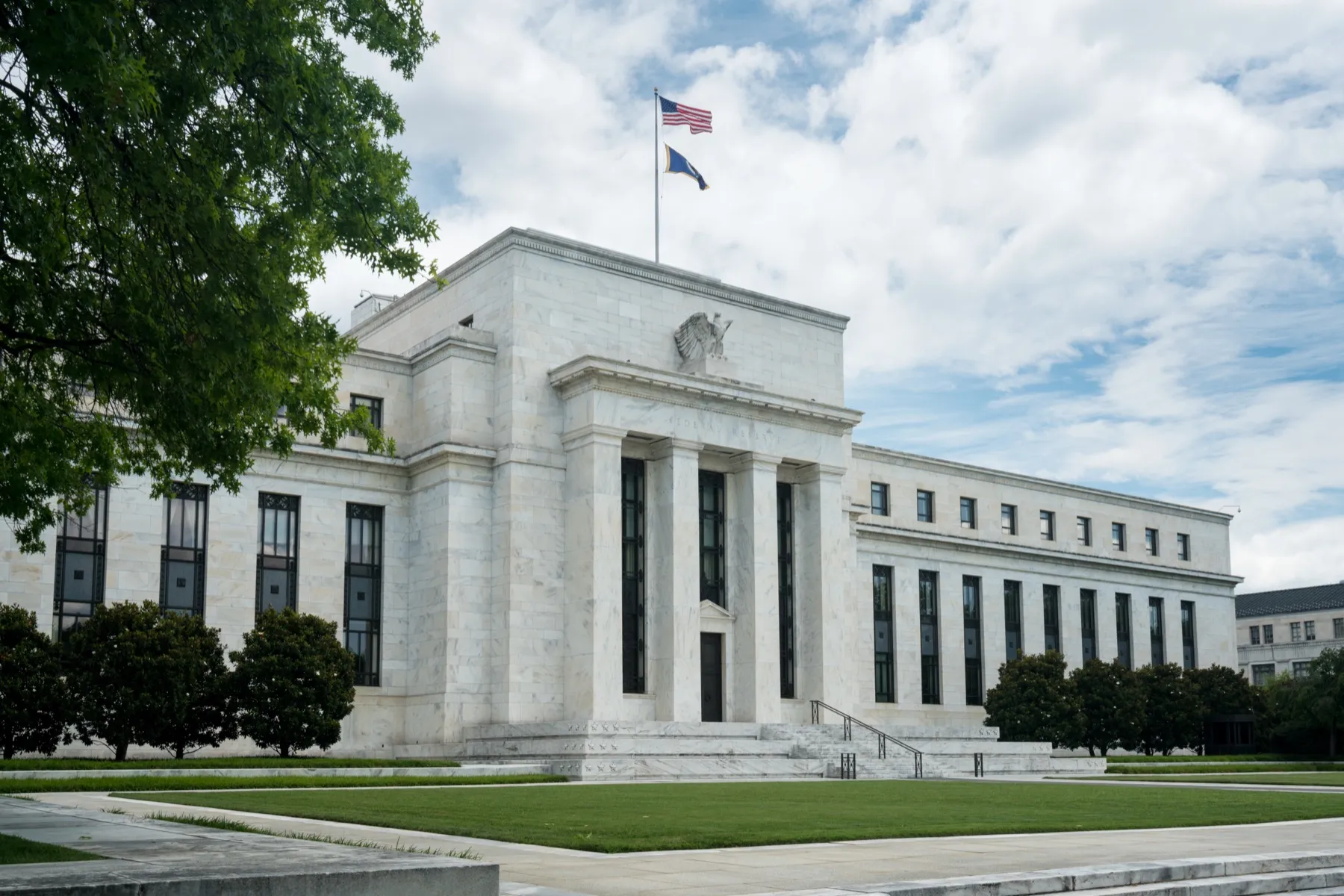
You do not need to forecast policy yourself to use this. Each central bank publishes its decisions, statements and meeting calendar; the Federal Reserve and the Bank of England both keep these on their homepages. Our EUR/USD trading guide applies the differential idea to the world’s most traded pair.
Rate expectations: why the market moves before the decision
Central banks rarely surprise anyone. Their officials give speeches, publish forecasts and drop hints for weeks before a meeting, and markets trade on every hint. Financial news services publish the market-implied probability of each outcome, worked out from interest rate futures. By the morning of a decision, the expected outcome is usually priced in: the exchange rate has already moved to reflect it.
So when the bank does exactly what was expected, there is often very little left to move. The reaction comes from the surprise, the difference between what the market expected and what it got. That surprise can come from three places:
- The decision. A bigger or smaller change than expected, or a hike or cut when the market expected a hold.
- The statement and projections. The written statement, and in some banks the officials’ own projections for future rates, show where policy is heading.
- The press conference. The governor’s answers to journalists can shift expectations further, for better or worse.
The second and third are known as forward guidance: what the bank tells you about the path of rates from here. And because markets price the whole future path, not just today’s rate, forward guidance often matters more than the decision. Many traders watch the two-year government bond yield as a running gauge of this, because it is very sensitive to where rates are expected to be over the next couple of years.
Hawkish vs dovish
The language of forward guidance has its own shorthand. Hawkish or dovish describes which way a central bank is leaning. Hawkish means leaning towards higher rates (or keeping them high) to fight inflation; dovish means leaning towards lower rates to support growth and jobs. A hawkish surprise tends to lift the currency; a dovish surprise tends to weaken it.
The words that signal each are fairly consistent. “Further tightening may be appropriate”, “inflation remains too high” and “vigilant” read hawkish. “Risks are now more balanced”, “monitor closely”, “progress on inflation” and anything about the economy slowing read dovish. Traders often compare the new statement with the previous one line by line, because a single changed phrase can matter more than the decision.
Why a rate hike can make a currency fall
Put those ideas together and the backwards reactions make sense. A bank that hikes as expected but says it is probably the last rise has, in effect, lowered the expected path of rates. The currency can fall on the day rates went up. The reverse is just as common: a bank that cuts as expected but signals no more cuts for a while can see its currency rise. The matrix below shows the typical pattern.
These are tendencies, not rules. The size of each reaction depends on how big the surprise is and how confident the market was beforehand. But they teach one habit worth keeping: before any decision, ask what is already expected, and judge the outcome against that, not against the previous rate. The Academy lesson on central banks and interest rates has a short quiz on exactly this.
Real vs nominal interest rates
The rate a central bank announces is a nominal rate. What an investor actually earns, once rising prices are taken into account, is the real rate: roughly the nominal rate minus inflation. A bond paying 5% in a country with 4% inflation leaves you about 1% better off in real terms. A bond paying 3% where inflation is 1% leaves you about 2% better off.
That difference matters because large, long-term investors think in real returns. A currency with a high headline rate is not automatically attractive if inflation is eating most of it, and a modest rate can be appealing if prices are stable. Over longer horizons, real rate differentials often explain currency trends better than nominal ones.
Real rates also explain a puzzle you will meet in inflation releases. A hotter-than-expected inflation figure usually strengthens a currency, because the market expects the central bank to respond with higher rates. But if inflation is running away and the market doubts the bank will act, the same news can weaken the currency, because real returns are falling and nobody trusts the policy. The difference is credibility. Our lesson on inflation and CPI walks through how a CPI surprise feeds into rate expectations.
When the link breaks: risk-off, crises and safe havens
The rate chain assumes investors are calmly hunting for the best return. In a panic, they stop hunting and start hiding. When fear takes over, risk-on and risk-off moods can swamp interest rates completely, and money floods into safe havens, chiefly the US dollar, the Japanese yen and the Swiss franc, regardless of what those currencies pay.
Tap a currency to see why it behaves this way.
Switch between risk-on and risk-off. In a panic, safe havens rise even when they pay little interest, and higher-yielding currencies fall even when their rates have not changed.
A few situations where the usual link weakens or reverses:
- Global fear. In the 2008 financial crisis, higher-yielding currencies such as the Australian and New Zealand dollars fell sharply against the yen, despite paying far more interest.
- Loss of confidence. Rising yields are only attractive if investors trust the country behind them. In September 2022, UK government bond yields jumped after a package of unfunded tax cuts, and the pound fell to a record low against the dollar at the same time. Higher yields were a sign of stress, not opportunity.
- Rate rises that hurt growth. If the market believes a hike will tip the economy into recession, it may sell the currency on the expectation that rates will have to come down again soon.
- Something bigger is happening. Trade disputes, elections or a sudden swing in commodity prices can dominate a currency for weeks, with rates pushed into the background.
Rates still matter, but they are one driver among several, and on some days not the loudest. Tap through the drivers below to see how rates sit alongside the others for the US dollar.
▲ Higher rates
▼ Lower rates
Higher interest rates attract foreign money seeking better returns, which must be converted into the currency first. Rate expectations are the single biggest driver of major currencies.
The five main drivers of the US dollar. Interest rates and rate expectations usually lead over weeks and months, but risk mood and growth can take over in the short run.
The Academy lesson on risk-on and risk-off sorts the major currencies into safe havens and risk currencies, and explains why the yen in particular tends to rise when markets are frightened.
The carry trade and the swap on your account
The interest rate differential is not only a force on price. It is also something you pay or earn every night you hold a position. The carry trade is the strategy built on that: borrowing in a low-rate currency and holding a higher-rate one to collect the difference.
For a retail trader, the carry shows up as the swap, the overnight interest your broker credits or charges for each night a position stays open. If you buy the currency with the higher rate against one with a lower rate, the swap may be positive; if you sell it, the swap will be negative. Brokers add their own margin to both sides, so on many pairs both directions cost something, and three nights are usually charged at once to cover the weekend. Our guide to forex trading costs and the lesson on trading costs show how swap adds up alongside spread and commission.
To get a feel for the size, take an illustrative gap of 4 percentage points on a position worth $100,000. Four per cent of $100,000 is $4,000 a year, or roughly $11 a night before the broker’s margin. That looks attractive, until you notice that a 1% move in the exchange rate against you is $1,000, about three months of carry wiped out in an afternoon. This is why the carry trade has a reputation for picking up coins in front of a steamroller: it earns steadily in calm markets, then gives back months of income at once when fear arrives and everyone closes the same positions together.
The leverage that makes a $100,000 position possible on a small account is exactly what makes that reversal so painful. If you hold positions for days or weeks, read our guide to leverage in forex before you let a positive swap tempt you into a larger size than your stop justifies.
How to read a central bank rate decision day, step by step
Every major central bank meets on a published schedule, usually about eight times a year, and announces at a fixed time. You will find each decision on the economic calendar, normally marked as high impact. Here is a routine for reading one, whether you plan to trade it or simply want to protect positions you already hold.
1. Find out what is expected. In the days before, note the consensus for the decision and how confident the market is. A decision priced as a near-certainty leaves room only for a surprise in tone; a finely balanced one can move the pair sharply either way.
2. Read the last statement. Know the wording the bank used last time, so you can spot what changes. A dropped phrase about “further increases” is a dovish signal even if the rate is unchanged.
3. Decide your position before the release. If you hold a trade in an affected pair, choose in advance whether to keep it, reduce it or close it. Spreads often widen sharply at the moment of release, and price can jump past a stop loss, causing slippage. Our guide on where to place a stop loss explains why stops near news are less precise than they look.
4. Judge the decision against the expectation. As the number comes out, ask only: more hawkish or more dovish than expected? Then do the same for the statement.
5. Wait for the press conference. At banks that hold one, such as the Fed and the ECB, it usually begins about half an hour after the decision. The first move is often reversed or extended by what the governor says.
6. Let the dust settle. The cleanest picture of how the market has absorbed the news usually comes hours later, not seconds. Many experienced traders do nothing until then.
Try the decision yourself below. Leave the actual figure equal to the forecast and notice how little happens, then move it a quarter of a point either way.
| Time | Cur. | Impact | Event | Previous | Forecast | Actual |
|---|---|---|---|---|---|---|
| 19:00 | USD | ●●● | Fed interest rate decision | 4.5% | 4.5% | — |
A mock Fed rate decision on the economic calendar. Slide the actual rate away from the forecast to see how the surprise, not the decision, drives the reaction in EUR/USD.
The Academy lesson on the economic calendar shows how to read forecast, previous and actual columns for every high-impact release, not just rate decisions.
Common mistakes when trading interest rate news
Trading the decision instead of the expectation
Buying a currency because “rates went up today” ignores that the move usually happened in the weeks before. Always compare the outcome with what was priced in, not with the previous rate.
Ignoring the other central bank
A hike from one bank means little if the other side of the pair is hiking just as fast. Look at the differential, and at which way it is heading.
Reading headlines, not guidance
The rate is announced in one line; the market moves on the paragraphs that follow and the answers in the press conference. Skim the decision, then read the statement properly.
Treating the swap as free money
A positive swap is small and steady; an adverse exchange rate move can be large and sudden. Size every position from your stop, not from the carry you hope to collect.
Holding full size through the release without a plan
Spreads widen and stops can slip on decision day. Decide before the release whether to hold, reduce or close, and accept that the worst-case loss may be larger than your stop suggests.
Frequently asked questions
Do higher interest rates make a currency stronger?
Usually, yes. Higher rates raise the return on holding a currency, which attracts foreign investors who must buy it first. But the effect depends on expectations: if a hike was already priced in, or the bank signals no more rises, the currency can fall. In a global panic, safe havens can rise regardless of rates.
Why did the currency fall after a rate hike?
Most likely because the hike was fully expected and the accompanying guidance was less hawkish than hoped. Markets price the future path of rates, so a hike described as the last one lowers expected rates and can weaken the currency on the very day rates rise.
What is an interest rate differential in forex?
It is the gap between the interest rates of the two currencies in a pair. When the gap widens in favour of one currency, money tends to flow towards it and the pair moves in that direction. The differential also sets the swap you pay or earn for holding a position overnight.
What does hawkish and dovish mean in forex?
Hawkish means a central bank leans towards higher rates, usually to fight inflation. Dovish means it leans towards lower rates to support growth. A more hawkish tone than expected tends to strengthen the currency, and a more dovish tone tends to weaken it, even if the rate itself does not change.
How long after a rate decision does the currency move?
The first move usually comes within seconds of the announcement. At banks that hold a press conference, a second move often follows about half an hour later. The full repricing can take hours or days as the market digests the statement, the projections and, later, the minutes.
Should I trade during a central bank rate decision?
That is your decision, but understand the conditions first. Spreads widen, prices can jump past stops and the first move is often reversed. Many traders reduce or close positions beforehand and wait for the dust to settle. If you do trade it, size the position for a larger loss than your stop implies.
Free course
Learn this step by step
“Fundamental Analysis” is a free BrokerCut Academy course: 9 short lessons (about 70 minutes), quizzes, interactive tools and a certificate when you finish.
Enrol free