USD/CHF Trading Guide: The Franc as a Safe Haven
USD/CHF trading explained: what moves the swissie, how the SNB and safe-haven flows push the franc, what a pip is worth and how EUR/CHF links in.

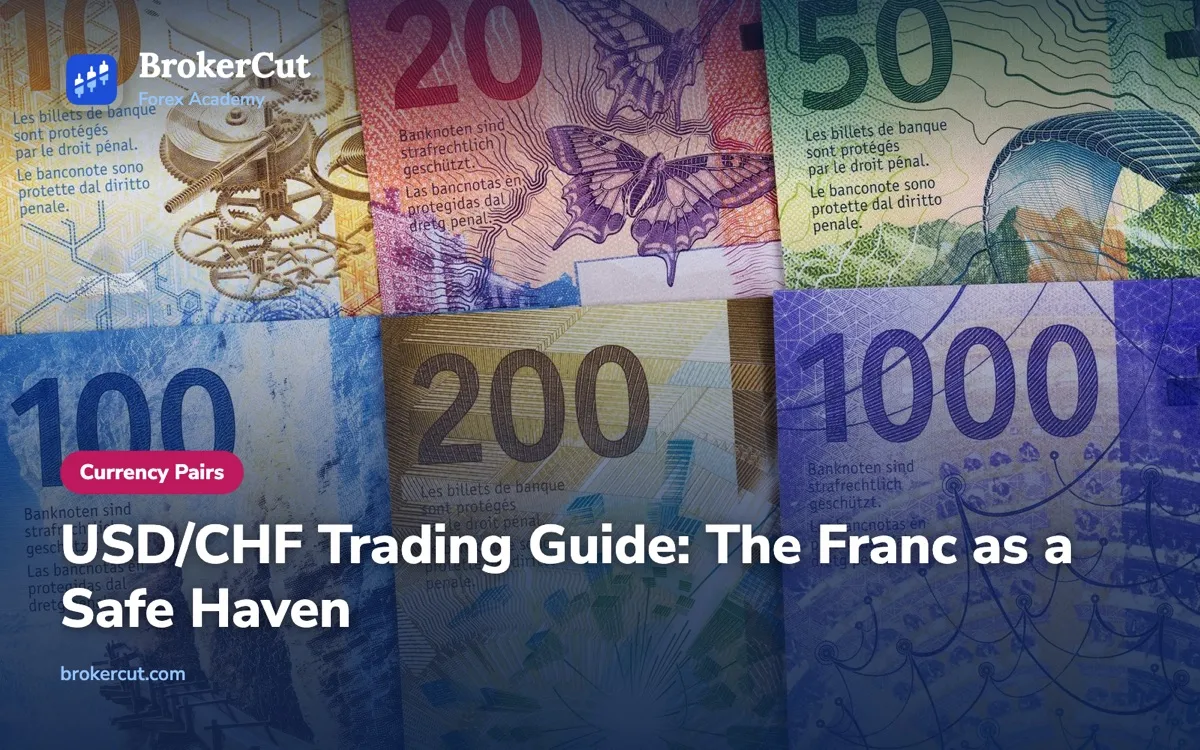
USD/CHF looks like any other dollar pair until markets get frightened. Then you find that both currencies in it are safe havens, that a central bank in Zurich has strong views about its own currency, and that the pair often behaves like EUR/USD seen in a mirror.
Quick answer: USD/CHF trading means trading the US dollar against the Swiss franc, a pair nicknamed the swissie. It moves on the gap between Fed and Swiss National Bank policy, on safe-haven flows and on EUR/CHF, and it usually moves opposite to EUR/USD. One pip is worth 10 francs per standard lot, about $11.36 at 0.8800.
What is USD/CHF? The swissie in plain English
USD/CHF is the exchange rate between the US dollar and the Swiss franc. The dollar is the base currency and the franc is the quote currency, so a price of 0.8800 means one US dollar buys 0.88 Swiss francs. When the price rises, the dollar is strengthening against the franc. When it falls, the franc is strengthening against the dollar. Traders call the pair the swissie, in the same spirit that EUR/USD is fiber and GBP/USD is cable.
It is one of the seven major pairs, the group that always includes the US dollar and is traded most heavily around the world. It is smaller than EUR/USD or USD/JPY by turnover, but still deep and liquid. CHF is the international code for the franc, taken from Confoederatio Helvetica, the Latin name for Switzerland.
The first thing that sets USD/CHF apart is that it sits below 1.0000 for long stretches. That only means one franc is worth more than one dollar. What matters for trading is the direction and the size of the change, not the level. The pair has spent time on both sides of parity in the past twenty years, and in August 2011, at the height of the euro debt crisis, it briefly fell close to 0.71.
The second thing is that USD/CHF is a meeting of two very different economies. The United States is huge, runs persistent trade deficits and issues the world’s reserve currency. Switzerland is small, open, runs large current-account surpluses and owns far more assets abroad than foreigners own in Switzerland. If you are new to reading pairs, the lesson on currency pairs and quotes covers base and quote currencies step by step.

USD/CHF pip value: why it is not $10
A pip on USD/CHF is the fourth decimal place, 0.0001, so a move from 0.8800 to 0.8830 is 30 pips. The counting is identical to EUR/USD. The value is not.
Because the franc is the quote currency, profit and loss on USD/CHF are counted in francs. One pip on a standard lot of 100,000 dollars is 100,000 × 0.0001 = 10 Swiss francs. To turn that into dollars you divide by the current USD/CHF price. At 0.8800, 10 ÷ 0.88 = $11.36 per pip.
| Lot size | Units of dollars | Pip value in francs | Pip value in USD at 0.8800 |
|---|---|---|---|
| Standard lot | 100,000 | CHF 10 | $11.36 |
| Mini lot | 10,000 | CHF 1 | $1.14 |
| Micro lot | 1,000 | CHF 0.10 | $0.11 |
The dollar figure moves with the price. When USD/CHF is lower, each franc buys more dollars, so a pip is worth more in dollar terms. When the price is higher, a pip is worth less.
This is the single most common arithmetic mistake on the pair. If you size a USD/CHF trade as though a pip were worth $10, every position is around 14% bigger than you intended at 0.8800. Our guide to pip value by currency pair shows the same conversion for every major, and the Academy lesson on pips and lots explains why the quote currency decides the pip value.
One convenience comes with the dollar being the base currency. A position of 0.10 lots is exactly $10,000 of exposure, so the margin your broker sets aside is easy to work out: at 1:30 leverage, $10,000 ÷ 30 = $333.33, whatever the price.
Spreads on USD/CHF
The spread on USD/CHF is usually a little wider than on EUR/USD, because fewer banks and funds trade it. During European and US hours it is normally modest; in thin Asian hours, around the daily rollover and in the seconds around major news it can widen sharply. Our guide to forex trading costs shows how spread and overnight swap add up.
What moves USD/CHF: the Fed, the SNB and the rate gap
Like every major pair, USD/CHF is driven over weeks and months by the gap between two sets of interest rates. On one side is the US Federal Reserve; on the other is the Swiss National Bank (SNB). Higher rates draw in foreign money, and that money has to buy the currency first. When US rates rise relative to Swiss rates, USD/CHF tends to rise. When the gap narrows, it tends to fall. Our guide to how interest rates affect currency explains the chain in full.
The dollar side
The US half of the pair reacts to the same events that move every dollar pair. The Fed meets eight times a year and announces at 19:00 UK time. The monthly jobs report, known as non-farm payrolls, and the CPI inflation report both land at 13:30 UK time for most of the year. A strong US surprise tends to lift USD/CHF, and a weak one tends to drag it down. There is more US news, so the dollar side often supplies most of the daily movement.
The franc side
The Swiss side is quieter but sharper. The SNB holds scheduled monetary policy assessments four times a year, in March, June, September and December, rather than the eight meetings of the Fed or the European Central Bank. Fewer meetings means each one carries more weight, and the SNB has a history of surprising markets, including between meetings.
The SNB defines price stability as Swiss consumer inflation of under 2% a year. Swiss inflation has been low by international standards for decades, partly because a strong franc makes imports cheaper. That gives the monthly Swiss CPI release from the Federal Statistical Office extra importance: a surprise moves expectations for the next SNB decision directly. Swiss GDP, the KOF economic barometer and the manufacturing PMI also matter, but rarely as much. The Academy lesson on inflation and CPI explains how to read an inflation release against its forecast.
Swap and the carry
Swiss interest rates have been lower than US rates for most of recent history, and below zero from 2015 to 2022. That gap shows up in your overnight swap. Holding long USD/CHF has tended to earn a small positive swap while US rates sit well above Swiss ones, and holding it short has tended to cost you, after the broker’s markup. The same gap made the franc a funding currency for carry trades, which matters a great deal in a panic, as the next section shows. Our guide to forex swap covers how the overnight charge is calculated.
The franc as a safe haven: a haven against a haven
The franc is one of the market’s traditional safe havens. Switzerland’s large net foreign assets, low debt, low inflation and long political neutrality mean that investors, especially in Europe, reach for francs when they are worried. When fear rises, carry trades funded in francs are closed and Swiss money abroad comes home, and both flows mean buying francs. Our guide to safe-haven currencies explains those mechanisms for the dollar, yen and franc in detail.
The twist with USD/CHF is that the dollar is a haven too. Switch the mood below and look at where both currencies sit.
Tap a currency to see why it behaves this way.
Switch between risk-on and risk-off. USD and CHF both sit with the safe havens, so a risk-off move lifts both sides of USD/CHF at once. Which way the pair goes depends on which haven is in more demand.
In a risk-off move, then, USD/CHF is a tug of war between two currencies that are both being bought. That is why the pair is a poor way to express fear on its own. The cleaner risk-on and risk-off gauges pair a risk-sensitive currency with a haven, such as AUD/JPY, or pit the franc against the euro. Our guide to risk-on vs risk-off covers those gauges.
What decides the winner is usually the kind of scare. The tree below sums up how the pair has tended to react.
Three cases are worth knowing:
- A dollar funding squeeze. When the problem is that the whole world needs dollar cash at once, the dollar tends to beat every other currency, the franc included. In the most intense week of the March 2020 dash for cash, USD/CHF rose while share markets were still falling.
- A scare centred on Europe. The franc’s haven role is strongest against the euro, its largest trading partner. In the euro debt crisis, money poured out of the euro and into francs. EUR/CHF took the biggest hit, and USD/CHF fell too, to its 2011 low.
- A scare centred on the United States. When the worry is US politics, US debt or the dollar itself, the dollar’s haven appeal fades and the franc tends to win.
The practical lesson is to ask what the scare is about before you assume which way USD/CHF will lean. The Academy lesson on risk-on and risk-off sorts the major currencies into havens and risk currencies if you want the full map.
The SNB: the biggest player in the franc
A haven currency is good news for Swiss savers and bad news for Swiss exporters and for an inflation target. When the franc rises too far, Swiss goods become expensive abroad and cheap imports push inflation towards zero or below. So the SNB has spent much of the past fifteen years leaning against franc strength. For anyone trading USD/CHF, it is the central bank to watch most closely, because it acts directly on the currency rather than only through interest rates.
The SNB’s recent history explains why traders take it so seriously:
- 2011: a floor. As money flooded into francs during the euro crisis, the SNB set a minimum exchange rate of 1.20 francs per euro in September 2011 and promised to buy foreign currency in unlimited amounts to defend it.
- 2015: the floor goes. On 15 January 2015 it removed the floor without warning and cut its deposit rate to −0.75%.
- 2015 to 2022: negative rates and intervention. The SNB kept its policy rate below zero and bought foreign currency heavily whenever the franc came under upward pressure.
- 2022 onwards: the reverse. As inflation rose, the SNB lifted rates above zero in September 2022 and sold foreign currency to strengthen the franc and hold down import prices. It then became one of the first major central banks to cut rates again, in March 2024, and had brought its policy rate back to zero by mid-2025.
For USD/CHF traders, the sharpest lesson is what January 2015 did to stop loss orders.
January 2015: why stops did not protect traders
On the morning of 15 January 2015, USD/CHF was trading at about 1.02. Within minutes of the announcement it had fallen below 0.80, before recovering part of the move later in the day. There was no orderly path down. Banks pulled their prices, and for a time there were simply no buyers of dollars against francs at most levels in between.
A stop loss becomes a market order once it is triggered, and a market order fills at the next available price. In an orderly market that is a pip or two away. In a gap it can be hundreds of pips away, which is called slippage. Some retail traders ended that day owing their brokers more than they had deposited. Negative balance protection, which retail clients in the UK and EU now receive by rule, exists to stop that from happening. Our guides to slippage and negative balance protection explain both in detail.
On a franc pair, a central bank with a very large balance sheet is an active participant, and its decisions can arrive between scheduled meetings. Size USD/CHF trades so that a gap well beyond your stop would hurt but not end your account. The lesson on central banks and interest rates explains how to read their signals and how hawkish or dovish language shifts expectations.

EUR/CHF and the negative correlation with EUR/USD
USD/CHF is tightly linked to two other pairs, and seeing why makes the swissie much easier to read. The three pairs EUR/USD, EUR/CHF and USD/CHF form a triangle: if you know any two, the third follows by arithmetic.
With EUR/USD at 1.0800 and EUR/CHF at 0.9500, USD/CHF must trade at about 0.9500 ÷ 1.0800 = 0.8796. If it did not, banks would buy the cheap side of the triangle and sell the dear side until the gap closed.
Now hold EUR/CHF still and move EUR/USD. If the dollar strengthens and EUR/USD falls to 1.0700, USD/CHF becomes 0.9500 ÷ 1.0700 = 0.8879, a rise. If the dollar weakens and EUR/USD rises to 1.0900, USD/CHF becomes 0.8716, a fall. That is the source of the strong negative correlation between the two pairs: the euro and the franc tend to move together against the dollar, because they are neighbouring European currencies and EUR/CHF usually moves far less than EUR/USD. The dollar is the base currency in one pair and the quote currency in the other, so the same dollar move shows up in opposite directions. Tap a cell in the grid to see how strong the link usually is.
Typical correlation between pairs
| EUR/USD | GBP/USD | AUD/USD | USD/JPY | USD/CHF | USD/CAD | |
|---|---|---|---|---|---|---|
| EUR/USD | ||||||
| GBP/USD | ||||||
| AUD/USD | ||||||
| USD/JPY | ||||||
| USD/CHF | ||||||
| USD/CAD |
Tap any cell to see what that correlation means for two open positions.
How many times are you really betting on the dollar?
Illustrative long-run correlations between USD/CHF and other major pairs, not live data. USD/CHF usually moves strongly against EUR/USD and GBP/USD and with USD/JPY, so these trades often overlap.
The mirror is a tendency, not a law. It breaks whenever EUR/CHF moves on its own, which is exactly what happens in a Europe-centred scare or after an SNB surprise. In January 2015 EUR/CHF collapsed, so USD/CHF fell hard while EUR/USD barely moved by comparison. Watching EUR/CHF tells you whether today’s USD/CHF move is a dollar story, which you will also see in EUR/USD, or a franc story, which you will not.
Two practical rules follow. First, buying EUR/USD and selling USD/CHF is not diversification: both are short-dollar trades, so together they are one larger bet. Second, buying EUR/USD and buying USD/CHF does not cancel out. The dollar legs offset, but you are left long the euro and short the franc, which is a long EUR/CHF position in disguise. Our guide to currency correlation and the lessons on correlations and correlation risk show how to count your real exposure. Try the second rule on yourself below.
What would you do?
You buy 0.10 lots of EUR/USD and 0.10 lots of USD/CHF, reasoning that one is long the dollar and one is short it, so your risk is small. That afternoon a eurozone banking scare sends investors into the franc. What happens?
When to trade USD/CHF, and a USD/CHF trading checklist
USD/CHF is a European and American pair. It is usually quiet through Asian hours, picks up when Zurich and London open, and is often most active in the London–New York overlap, when US data lands and both of its home regions are at their desks. The clock below converts the main sessions into your own time zone.
Open now: …
The four forex sessions in your local time. USD/CHF usually wakes up with the European open and is often busiest in the London–New York overlap, when US data and the dollar side of the pair dominate.
The key Swiss moments come early in the European day. Swiss CPI and most other Swiss data are published in the Swiss morning, and the SNB announces its quarterly decisions in the morning too, around 08:30 UK time, with a press conference afterwards. US data at 13:30 UK time and Fed decisions at 19:00 drive the dollar side. Our guide to forex market hours and the Academy lesson on market sessions cover time zones and daylight saving in detail.
Everything in this guide comes down to a short routine before you trade the pair. Tick through it before each session; it saves in your browser.
USD/CHF trading checklist
0 of 8
Position sizing on USD/CHF has one extra step compared with EUR/USD: converting the franc pip value into your account currency. The worked example below does it with a dollar account, then adds the stress test that the 2015 episode argues for. Our guide to position sizing and the lesson on risk per trade cover the standard method.
Common mistakes when trading USD/CHF
Using a $10 pip value
On USD/CHF a pip is worth CHF 10 per standard lot, which is more than $10 whenever the pair trades below 1.0000. Sizing with $10 makes every position larger than you meant. Convert the pip value at the current price before you size, every time.
Treating USD/CHF as a simple safe-haven trade
Buying francs because “markets are scared” ignores the fact that the dollar is a haven too. In a dollar funding squeeze, USD/CHF can rise in a panic. Ask what the scare is about first.
Forgetting the SNB
The SNB has set a floor, removed it without warning, held rates below zero for more than seven years and bought or sold foreign currency on a large scale. Assuming the franc will move freely in either direction, or betting on what the SNB “must” do next, ignores the largest participant in the market.
Stacking dollar trades by accident
Long EUR/USD, long GBP/USD and short USD/CHF look like three ideas. They are one large short-dollar position, and one strong US data release can stop out all three. Count currencies, not tickers.
Trusting a stop to cap a franc shock
A stop limits your loss only if the market trades through it in an orderly way. Size franc trades so that a gap well beyond your stop is painful but survivable, especially around SNB decisions and over weekends.
Frequently asked questions
Why is USD/CHF called the swissie?
Swissie is long-standing trader slang for USD/CHF, taken from the Swiss franc on the quote side of the pair. It works like the nicknames fiber for EUR/USD and cable for GBP/USD. You will see it in market commentary and trader chat; it means exactly the same thing as USD/CHF.
How much is a pip worth on USD/CHF?
One pip on a standard lot of USD/CHF is worth 10 Swiss francs, because the franc is the quote currency. In US dollars that is 10 divided by the current price: about $11.36 at 0.8800 and $12.50 at 0.8000. A mini lot is worth one tenth of that and a micro lot one hundredth.
Is the Swiss franc still a safe haven?
Broadly, yes. Switzerland's large foreign assets, low inflation, low debt and political stability mean investors still buy francs when they are worried, especially about Europe. The Swiss National Bank has often leaned against that strength with low rates and currency intervention, and in a pure dollar scramble the dollar usually beats it.
Why does USD/CHF move opposite to EUR/USD?
The dollar is the base currency in USD/CHF and the quote currency in EUR/USD, so the same dollar move pushes them in opposite directions. The euro and franc also tend to move together because EUR/CHF is usually steadier than EUR/USD. The link weakens when EUR/CHF moves sharply on its own.
What happened to the Swiss franc in January 2015?
On 15 January 2015 the Swiss National Bank removed its minimum rate of 1.20 francs per euro without warning and cut its deposit rate to −0.75%. The franc jumped within minutes: USD/CHF fell from about 1.02 to below 0.80 before partly recovering, and many stop orders filled far beyond their levels.
When is USD/CHF most active?
USD/CHF is usually most active from the European open through the London–New York overlap, roughly 07:00 to 17:00 UK time. Swiss data and SNB decisions come in the European morning, and US data at 13:30 UK time. Asian hours are usually quiet, with wider spreads and smaller moves.
Free course
Learn this step by step
“Fundamental Analysis” is a free BrokerCut Academy course: 9 short lessons (about 70 minutes), quizzes, interactive tools and a certificate when you finish.
Enrol free