NZD/USD Trading Guide: Dairy, Rates and Risk Appetite
NZD/USD trading explained: how the RBNZ, dairy auctions and risk appetite move the kiwi, what a pip is worth and when the pair is most active.

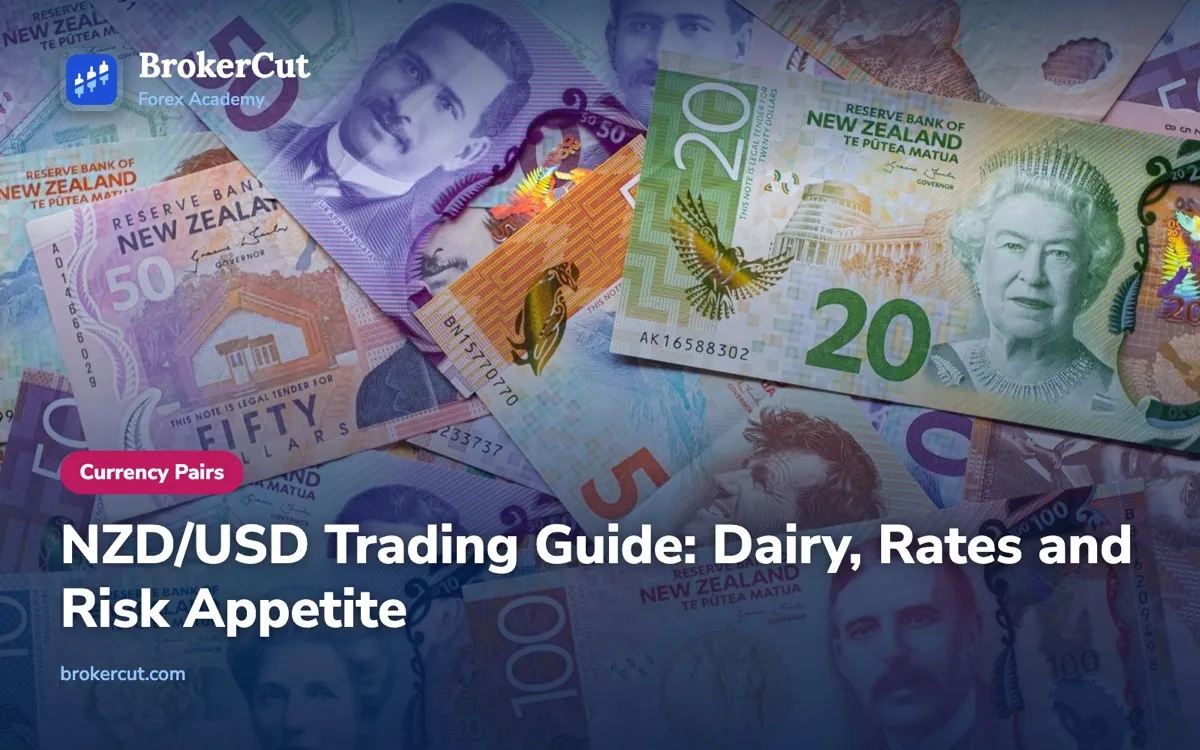
The New Zealand dollar belongs to an economy of around five million people, yet it is one of the most watched currencies in the world. NZD/USD trading puts a small, farm-exporting country up against the world’s reserve currency, and the moves often start somewhere you were not looking: a milk-powder auction, a rate decision in the middle of your night, or a sell-off on Wall Street.
Quick answer: NZD/USD is the price of one New Zealand dollar in US dollars, nicknamed the kiwi. It moves mainly on the gap between Reserve Bank of New Zealand and Federal Reserve interest rates, on dairy export prices and on global risk appetite. It is thinner than EUR/USD, tracks AUD/USD closely and reacts to news released during Asia-Pacific hours.
What is NZD/USD? The kiwi in plain English
NZD/USD is the exchange rate between the New Zealand dollar and the US dollar. The New Zealand dollar is the base currency and the US dollar is the quote currency, so a price of 0.6000 means one New Zealand dollar costs 60 US cents. When the price rises, the kiwi is strengthening; when it falls, the dollar is. The nickname comes from the kiwi bird on New Zealand’s one-dollar coin, and traders use “kiwi” for both the currency and the pair.
Three things make the kiwi different from the European majors.
First, it is a commodity currency. Dairy is New Zealand’s largest goods export by a distance, with meat, timber, fruit and wine behind it, and China is its biggest customer. When the world pays more for what New Zealand sells, the country earns more and its currency tends to follow. Our guide to commodity currencies explains the general mechanism; this guide applies it to one pair.
Second, it is a small currency with a big following. New Zealand has often paid higher interest rates than most developed economies, making the kiwi a favourite of carry trade investors, whose money arrives quickly in calm markets and leaves just as quickly in a panic.
Third, it shares a neighbour’s moods. Australia and New Zealand sell to the same Asian customers and react to the same global news, so NZD/USD and AUD/USD usually move together. Knowing when they don’t is one of the more useful skills in NZD/USD trading.
NZD/USD is usually counted among the seven major pairs, but it is the least traded of them. That matters for cost and for how the pair behaves at quiet times, which is the next section.
NZD/USD pip value, spreads and liquidity
A pip on NZD/USD is the fourth decimal place, 0.0001. A move from 0.6000 to 0.6035 is 35 pips. Because the US dollar is the quote currency, profit and loss are counted in dollars, so the pip value is fixed whatever the exchange rate:
| Lot size | New Zealand dollars | Value of one pip |
|---|---|---|
| Standard lot | 100,000 | $10 |
| Mini lot | 10,000 | $1 |
| Micro lot | 1,000 | $0.10 |
That is the same $10 as EUR/USD, which keeps sizing simple. What differs is the size of the position behind each pip. At 0.6000, a standard lot of kiwi is worth only $60,000, compared with roughly $108,000 for a standard lot of EUR/USD at 1.08. Our guide to pip value by currency pair works through every type of pair, and the lesson on pips and lots covers the basics.
Thinner than the big majors
Liquidity is how easily a market absorbs orders without the price jumping. The Bank for International Settlements’ Triennial Survey consistently shows the New Zealand dollar’s share of global turnover as a small fraction of the euro’s or the yen’s. Fewer banks quoting means three practical differences for you:
- The spread is usually a little wider than on EUR/USD, and it widens more at quiet times: around the daily rollover late in the US evening, and in the gap between the New York close and the Asia-Pacific open.
- Moves can be jumpier around news, because there is less resting liquidity to absorb a rush of orders. Stops are more likely to suffer slippage in those moments.
- Leverage limits can be lower. Under UK and EU retail rules, the highest leverage of 1:30 applies only to pairs made up of the US dollar, euro, pound, yen, Canadian dollar and Swiss franc. NZD/USD falls in the next band, usually 1:20, so the same position needs more margin.
During busy hours it is still a liquid, widely quoted pair; the cost of trading it at the wrong time of day is higher. Our guide to forex trading costs shows how the costs add up.
When to trade NZD/USD: Wellington opens first
New Zealand sits just west of the International Date Line, so Wellington is the first major financial centre to start each new day. The forex week begins on Monday morning in Wellington, which is still Sunday evening in the UK. Any news from the weekend, such as a political surprise or a shock in global markets, shows up first in thin Monday-morning trading in the kiwi and the Aussie, often as a gap from Friday’s close. The clock below shows the main sessions in your own time zone. Wellington is not drawn separately: it opens roughly two hours before Sydney, at the very start of the inner ring.

Open now: …
The four main forex sessions in your local time. Wellington opens about two hours before Sydney, the inner ring, so NZD/USD's own news arrives at the very start of the Asia-Pacific day, while US news lands in the London–New York overlap on the outer ring.
Unlike EUR/USD, which has one busy stretch of the day, NZD/USD has two windows that matter:
- The Asia-Pacific window. New Zealand’s own data, the Reserve Bank’s decisions, Australian figures and Chinese releases all land here. For a UK-based trader this is late evening and the early hours, when spreads are wider and few people are at their screens.
- The London–New York overlap. The kiwi’s other half is the US dollar, so US jobs and inflation data at 13:30 UK time, and Fed decisions in the UK evening, move NZD/USD as much as any New Zealand news.
So the most important New Zealand events usually happen while European traders are asleep, and an overnight kiwi position is held through them whether you planned it or not. Statistics New Zealand publishes its main releases at 10:45 a.m. Wellington time, and the Reserve Bank announces at 2 p.m., which puts both in the UK night.
So when should you trade it? If you are based in Europe, the London–New York overlap is usually the most practical window: the pair is liquid, spreads are at their tightest and US news provides the movement. Just check the calendar for what happened, or will happen, in the Asia-Pacific window before you take a position. The lesson on market sessions and our guide to forex market hours cover time zones and daylight saving in detail.
What moves NZD/USD: the RBNZ and the rate gap
Over weeks and months, the biggest single driver of NZD/USD is the difference between New Zealand and US interest rates, and above all where markets expect that difference to go next.
The Reserve Bank of New Zealand (RBNZ) sets the Official Cash Rate, or OCR, seven times a year. It was the first central bank to adopt a formal inflation target, and today it aims to keep inflation between 1% and 3% over the medium term, with a focus on the 2% midpoint. On the other side sits the US Federal Reserve. When New Zealand rates are high relative to US rates, holding kiwi pays more, which draws in yield-seeking money. When the gap shrinks, that support fades.
The RBNZ publishes its own forecast for rates
The RBNZ publishes a projected path for the OCR in its quarterly Monetary Policy Statements: the bank shows where it thinks its own rate is heading over the next couple of years. The market, meanwhile, has its own expectations built into prices.
That creates a clean test on decision day. If the bank’s projected path is higher than what the market had priced in, the message is hawkish and the kiwi tends to rise, even if the rate itself was left unchanged. If the path is lower, it is dovish and the kiwi tends to fall.
Why the rate gap moves the kiwi so much
Rate differentials move every currency, but the kiwi is unusually sensitive to them because of the carry trade. For long stretches New Zealand paid some of the highest rates in the developed world; before the 2008 financial crisis the OCR reached 8.25%. Investors borrowed cheaply in yen or Swiss francs and parked the money in kiwi to collect the difference. That works while markets are calm and the gap stays wide. When the gap narrows, or a scare makes investors cut risk, those positions are unwound together and the kiwi can fall faster than the news alone would justify. Our guide to the carry trade explains how this builds and unwinds.
Because the RBNZ targets inflation, the New Zealand data that matters most is the data that changes rate expectations. New Zealand publishes CPI inflation quarterly rather than monthly, so each release carries a whole quarter’s information and can produce a large move. The quarterly labour market report and GDP figures follow the same logic. All are published by Stats NZ. The lesson on central banks and interest rates walks through the full chain from decision to exchange rate, and our guide to hawkish and dovish language shows how to read the statement itself.
Dairy and the Global Dairy Trade auction
If interest rates set the kiwi’s trend, dairy is its most distinctive driver. Dairy products, mainly whole milk powder, butter and cheese, make up roughly a quarter to a third of New Zealand’s goods exports by value. A sustained rise in dairy prices means more export income, better farm earnings, more spending in rural towns and, eventually, a stronger economy that gives the RBNZ less reason to cut rates.
Prices are discovered in public. The Global Dairy Trade (GDT) platform runs online auctions roughly every two weeks, usually on a Tuesday, where large buyers bid for contracts to receive dairy products in the months ahead. Each event publishes a headline price index showing the average change since the previous auction, plus results for individual products such as whole milk powder. The results arrive overnight in New Zealand time, which falls in the European afternoon or evening.
How much does one auction matter?
Usually, not much. A change of a percent or two in the price index is routine. What gets attention is a run of auctions in the same direction, or a single large surprise, especially in whole milk powder, which is the product most tied to Chinese demand. Even then, the reaction often comes through the slow route: economists revise their forecasts for farm incomes, and the market starts to reconsider the RBNZ’s next moves.
Two quirks are worth knowing. New Zealand’s milk season peaks in the southern spring, around October and November, and a drought can lift global prices even as it cuts the volume the country has to sell. And because China is the biggest buyer, a dairy move is often really a signal about Chinese demand, which also moves the Australian dollar. That is one reason the kiwi so often moves with the Aussie, as the commodities and currency correlations lesson points out.

A rising auction trend behind a bullish NZD/USD setup adds some confidence to it. Your risk per trade stays where your plan sets it.
Risk appetite and China: why the kiwi is a risk-on currency
The third big driver has little to do with New Zealand at all. When investors are confident, often called risk-on, money flows into higher-yielding and growth-linked currencies, and the kiwi is one of them. When fear rises, money flows back into the US dollar, the yen and the Swiss franc, and the kiwi is sold. Switch the mood below to see where the New Zealand dollar sits.
Tap a currency to see why it behaves this way.
Risk-on and risk-off tendencies across eight currencies. The New Zealand dollar sits on the risk-on side with the Australian and Canadian dollars, while the US dollar is a safe haven, so a scare tends to push NZD/USD down from both sides at once.
For NZD/USD this effect is doubled. In a risk-off move the kiwi tends to weaken and the US dollar tends to strengthen, so the pair falls from both ends. That is why NZD/USD can drop sharply on a day with no New Zealand news at all, simply because global share markets are selling off. The panic of March 2020 was a vivid example: the kiwi fell hard against the dollar in a matter of days, long before any New Zealand data could reflect what was happening.
China adds another layer. As New Zealand’s largest export market, its monthly activity and trade data can move the kiwi during the Asia-Pacific session, and a run of weak Chinese numbers tends to weigh on the kiwi and the Aussie together.
In practice, a quick look at risk mood before you trade is worth more than an hour of dairy analysis: if share markets are falling and the yen is rising, a long kiwi position is swimming against the tide. Our guide to risk-on and risk-off and the lesson on risk-on and risk-off explain how each major currency behaves in each mood.
NZD/USD and AUD/USD: reading the kiwi against the Aussie
Most of the time NZD/USD and AUD/USD move in the same direction. They share the US dollar as the quote currency, both are commodity currencies, both sell heavily to China and both respond to risk mood. The Academy uses an illustrative long-run correlation of around +0.8 between them, and over many periods it has been higher.
That relationship is useful in two ways, and dangerous in one.
Using AUD/NZD to see what is New Zealand-specific
The cross rate AUD/NZD is AUD/USD divided by NZD/USD. If both pairs fall by the same proportion, the cross barely moves. If only the kiwi falls, the cross rises. So the cross acts as a filter: it strips out the shared drivers and shows you what is happening between the two countries themselves.
Before you trade NZD/USD on a New Zealand story, glance at AUD/NZD. If the cross has not moved, the market is treating the day as a shared Asia-Pacific or dollar move, not a kiwi move. If the cross has jumped, something specific to New Zealand is being priced. Note that the cross has a different pip value: because the New Zealand dollar is its quote currency, a pip on AUD/NZD is worth NZ$10 per standard lot, which is $6 when NZD/USD is at 0.6000.
The danger: two trades that are really one
The trap is opening long AUD/USD and long NZD/USD and calling it two ideas. Try the decision below.
What would you do?
You are long AUD/USD, risking 1% of your account. An hour later, NZD/USD shows a very similar buy setup on the same timeframe. Your plan allows 1% risk per trade.
The lesson on correlation risk shows how to cap combined exposure, and our guide to currency correlation explains how to measure the link yourself. For the Australian side of the story, read our AUD/USD trading guide.
NZD/USD trading: a practical routine and a worked example
Everything above comes together in a short routine. Because the kiwi’s own news lands in the Asia-Pacific night, the key habit is checking what happened, or is about to happen, while you were away. Tick through the list before your session; it saves in your browser.
NZD/USD trading-day checklist
0 of 9
The last item matters more on the kiwi than on most pairs. An RBNZ surprise at 2 p.m. in Wellington can move the pair tens of pips in a minute while you are asleep, and in thin overnight liquidity a stop loss may fill some distance beyond where you placed it. Step through the sketch below, then read the numbers.
Illustrative NZD/USD sketch, not real data: a long position opened at 0.5980 with a 30-pip stop, held overnight into a dovish RBNZ surprise. The price drops through the stop and the order fills at 0.5938.
The extra loss came from holding through a scheduled event in thin hours, not from the trade idea. Our guides to position sizing and slippage cover the arithmetic, and the lesson on position sizing has a calculator you can use for any pair.
Common mistakes when trading NZD/USD
Forgetting the kiwi’s news happens at night
The most expensive habit in NZD/USD trading is holding a position into an RBNZ decision or a quarterly CPI release without realising it was scheduled. For a UK trader, both land in the small hours. Check the calendar for the Asia-Pacific window every day you hold a kiwi position.
Treating one dairy auction as a signal
A single auction result that moves a percent or two is usually noise. The kiwi responds to the trend in dairy prices and to large surprises. Use dairy as background, not as an entry trigger.
Trading the kiwi and the Aussie as separate ideas
Long NZD/USD and long AUD/USD, or long NZD/USD and short USD/CAD, can look like a diversified set of trades. In a risk-off sell-off they behave like one large position. Count them together and cap the combined risk.
Ignoring the US side of the pair
Half of NZD/USD is the US dollar, and a careful view on New Zealand can be overwhelmed by one strong US jobs or inflation report. Our EUR/USD trading guide covers the US calendar in more detail.
Trading the quiet hours
Between the New York close and the Asia-Pacific open, and on Monday mornings in Wellington, liquidity is thin and spreads are wide, so trades cost more and fill less reliably.
Frequently asked questions
Why is NZD/USD called the kiwi?
The New Zealand one-dollar coin carries an image of a kiwi, the country's national bird, so traders adopted the name for the currency and the pair. You will see “kiwi” in commentary and on dealing desks, just as AUD/USD is often called the Aussie and GBP/USD is called cable.
How much is 1 pip worth on NZD/USD?
Because the US dollar is the quote currency, one pip on NZD/USD is worth $10 on a standard lot of 100,000 New Zealand dollars, $1 on a mini lot and 10 cents on a micro lot. If your account is in another currency, your broker converts that dollar value at the current rate.
What time does the RBNZ announce interest rate decisions?
The Reserve Bank of New Zealand announces its Official Cash Rate decisions at 2 p.m. Wellington time, seven times a year. For traders in the UK that is in the early hours, roughly between 01:00 and 03:00 depending on daylight saving in each country, so check the calendar in your own time zone.
Does dairy really move the New Zealand dollar?
Yes, but loosely. Dairy is New Zealand's largest goods export, so a sustained trend in dairy prices affects export income, growth and the RBNZ's outlook. A single auction rarely moves NZD/USD much on its own; large surprises and runs in one direction matter more.
Why do NZD/USD and AUD/USD move together?
Both are priced against the US dollar, both are commodity currencies, both sell heavily to China and both respond to global risk mood. That shared exposure makes their correlation high most of the time. They separate when one country has its own story, such as a surprise rate decision.
Is NZD/USD good for beginners?
It can be, with care. It has a simple $10 pip value and clear drivers, but it is less liquid than EUR/USD, its spreads are usually a little wider and its own news arrives during Asia-Pacific hours. Many beginners start with the most liquid pairs and add the kiwi once they have a routine.
Free course
Learn this step by step
“Fundamental Analysis” is a free BrokerCut Academy course: 9 short lessons (about 70 minutes), quizzes, interactive tools and a certificate when you finish.
Enrol free