What Is Margin in Forex? Margin Calls and Margin Level
What is margin in forex? Learn how required margin, equity, free margin and margin level work, and exactly when a margin call or stop-out happens.


Under every open trade, your platform shows a row of numbers: balance, equity, margin, free margin, margin level. Most new forex traders ignore them until one turns red and a trade closes on its own.
Quick answer: Margin in forex is the part of your own money a broker locks as a deposit while a leveraged trade is open. It is not a fee. Required margin is the position value divided by the leverage. Your margin level, equity divided by used margin, decides when you get a margin call and when positions are closed automatically.
What is margin in forex?
Margin is a deposit. When you open a leveraged position, your broker sets aside part of your account as collateral, to show that you can cover the normal ups and downs of the trade. While the trade is open, that money is locked and you cannot use it for anything else. When you close the trade, it is released back to you, plus any profit or minus any loss.
Margin is not a cost. The spread, any commission and the overnight swap are costs; you pay them and they are gone. Margin is more like the deposit you leave when you hire a car. It belongs to you the whole time. The car company holds it until you bring the car back.
Margin exists because of leverage. Leverage lets you control a position worth far more than your deposit, and the margin is the slice of the position’s value that you must actually put up. The two are the same idea seen from opposite ends: 1:30 leverage means a margin rate of one thirtieth, or 3.33%. Our guide to leverage in forex covers why leverage magnifies gains and losses; this article is about the mechanics of the deposit itself and what your broker does with it.
You will see a few related terms. The margin rate is the percentage the broker asks for, required margin is that percentage in money for one trade, and used margin is the total locked across all open trades. The Academy lesson on leverage and margin introduces them with a short quiz.
How to calculate required margin
There is one formula, written two ways:
- Required margin = position value ÷ leverage
- Required margin = position value × margin rate
The position value, sometimes called the notional value, is the size of the trade in your account currency. For a pair quoted in US dollars, such as EUR/USD or GBP/USD, it is lots × 100,000 × the price. For a pair where the US dollar is the base currency, such as USD/JPY, a dollar account needs no conversion: one lot is $100,000. If you are unsure how lots translate into units, our guide to lot sizes in forex and the lesson on pips and lots explain it.
| Trade | Position value | Margin at 1:30 (3.33%) | Margin at 1:100 (1%) |
|---|---|---|---|
| 1 lot EUR/USD at 1.0800 | $108,000 | $3,600 | $1,080 |
| 0.5 lots EUR/USD at 1.0800 | $54,000 | $1,800 | $540 |
| 0.3 lots GBP/USD at 1.2700 | $38,100 | $1,270 | $381 |
| 0.3 lots USD/JPY at 150.00 | $30,000 | $1,000 | $300 |
Three details catch people out. First, the required margin moves with the price: as EUR/USD rises, 50,000 euros are worth more dollars and need slightly more margin. Most platforms recalculate it continuously. Second, the leverage on a pair can be lower than your account’s headline figure. Under UK and EU retail rules, major pairs are capped at 1:30 and other pairs at 1:20, so a minor pair needs a 5% deposit. Third, some brokers raise margin requirements before weekends or major events. Your account terms will say if yours does.
The slider below starts from the trade we will follow through this guide: a $2,000 account buying 0.5 lots of EUR/USD at 1:30. (It uses a price of 1.0850, so its margin figure is a few dollars higher than the $1,800 in our example.) Move the leverage and watch the margin bar change while the cost of a 50-pip move stays put.
Margin locked up Loss from a 50-pip move against you
At 1:30 the margin takes up about 90% of the account. That is legal, and the platform will happily accept it. It is also the reason this trade will run into trouble so quickly, as you will see shortly.
Balance, equity, used margin and free margin
Open the account panel on any trading platform and you will find the same four numbers. They are worth learning by heart, because every margin rule is written in terms of them.
- Balance is the money in the account, counting only closed trades, deposits, withdrawals and charges already taken. It does not move while a trade is open.
- Equity is the balance plus or minus the running profit or loss on open trades. It is what the account would be worth if you closed everything now, and it changes with every tick.
- Used margin is the total deposit locked by your open positions.
- Free margin is equity minus used margin. It is what is left to open new trades or to absorb further losses.
Take a calmer trade than the one in the slider. A $2,000 account buys 0.2 lots of EUR/USD at 1.0800 with 1:30 leverage. The position is worth $21,600, so the used margin is $720. Each pip is worth $2. The price then drops 50 pips, giving an open loss of $100.
The loss does not come out of the margin; the margin stays at $720 because the position has not changed size. The loss comes out of equity, and therefore out of free margin. That is why free margin shrinks first as a trade goes against you, and why it can fall below zero: once losses are bigger than the original free margin, equity is smaller than the deposit the broker is holding. Most platforms will show a negative free margin at that point rather than closing anything straight away.
Margin level: the number your broker watches
Of the five numbers on the panel, one matters more than the others for keeping a position open.
Margin level = equity ÷ used margin × 100
In the example above, $1,900 ÷ $720 × 100 gives a margin level of about 264%. It tells you, in a single figure, how much equity stands behind each dollar of deposit. At 100%, equity exactly equals the margin locked up, and free margin is zero. Below 100%, the account is holding less money than the deposit the broker requires. When there are no open trades there is no used margin, so most platforms leave the margin level blank.
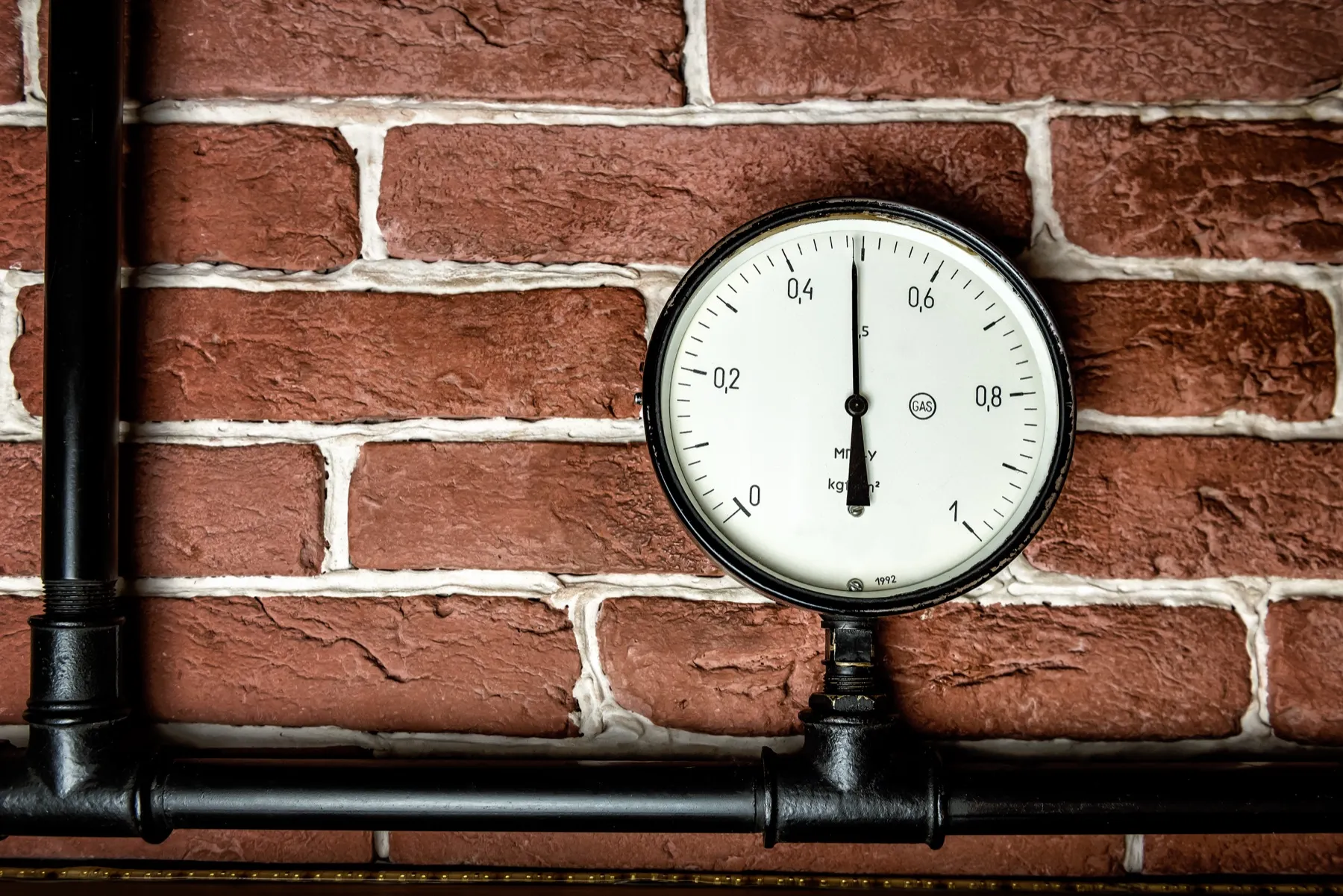
Margin level also tells you how much leverage you are really using. At a 1:30 account, a margin level of 300% means your positions are worth ten times your equity; 3,000% means they are worth about the same as your equity. The heavy trade from the slider, 0.5 lots on $2,000, opens at a margin level of just 111%, which works out at positions worth 27 times the account. You can see how little room that leaves on the gauge.
A higher margin level always means more room before the broker steps in. Traders who size positions from a stop loss rather than from the margin available rarely see a figure anywhere near 111%.
Margin call and stop-out levels explained
Brokers act at two thresholds, both measured as a margin level. The exact figures depend on your broker and your regulator, so look them up in your account terms before you trade.
The margin call
A margin call is a warning. The name dates from when brokers telephoned clients to ask for more money; today it is an on-screen alert or an email. Brokers commonly set it at a margin level of 100%, the point where free margin reaches zero, though some use a different figure.
At the margin call, nothing is closed. What changes is that you can no longer open new positions, because you have no free margin left to put up as a deposit. You have three choices: close or reduce positions, add funds, or wait and see if the price recovers. Only the first deals with the cause.
The stop-out
The stop-out, also called the margin close-out, is the broker acting rather than warning. Under rules introduced by the European Securities and Markets Authority (ESMA) in 2018, brokers must close a retail client’s positions once equity falls to 50% of the margin required, measured across the whole account. The UK’s Financial Conduct Authority applies the same 50% rule, and Australia has a similar one. Brokers regulated elsewhere set their own stop out level, which can be lower.
Here is the full sequence on the heavily sized trade, step by step.
The table shows the same trade in more detail, ignoring the spread. Each pip on 0.5 lots is worth $5, and the used margin is treated as fixed at $1,800.
| EUR/USD price | Pips against you | Open loss | Equity | Free margin | Margin level |
|---|---|---|---|---|---|
| 1.0800 | 0 | $0 | $2,000 | $200 | 111% |
| 1.0780 | 20 | −$100 | $1,900 | $100 | 106% |
| 1.0760 | 40 | −$200 | $1,800 | $0 | 100% |
| 1.0700 | 100 | −$500 | $1,500 | −$300 | 83% |
| 1.0650 | 150 | −$750 | $1,250 | −$550 | 69% |
| 1.0600 | 200 | −$1,000 | $1,000 | −$800 | 56% |
| 1.0580 | 220 | −$1,100 | $900 | −$900 | 50% |
A move of 220 pips in EUR/USD is not rare. It can happen in a few days, or in a single session around a major central bank decision. On this position size, an ordinary week can cost more than half the account.
What happens at the stop-out
When the margin level touches the close-out level, the platform closes positions automatically at the next available price. If you hold several, it commonly closes the largest losing position first, then checks the margin level again and continues one position at a time until the level is back above the threshold. Whatever is left stays open.
Two things are worth knowing about that process. First, the close happens at the market price, not at exactly 50%. In a fast market or over a weekend gap, the fill can be well below the threshold, so the loss can be bigger than the arithmetic suggests. In the UK, the EU and Australia, retail clients also have negative balance protection, so the account cannot go below zero, but that protects you from debt, not from losing your deposit. Second, the stop-out is not a stop loss. You did not choose the price, and by the time it acts, most of the damage is done. Our guide on where to place a stop loss shows how to pick an exit that closes a losing trade long before the broker has to.
Margin on multiple positions and hedged positions
Margin is worked out per position, but the margin call and the stop-out are worked out for the whole account. Every open trade adds its deposit to the used margin, and all of them share one pool of equity. A loss on any one trade lowers the margin level for all of them.
The three trades in the figure are 0.2 lots of EUR/USD at 1.0800 ($720), 0.15 lots of GBP/USD at 1.2700 ($635) and 0.15 lots of USD/JPY at 150.00 ($500), all at 1:30. Buying EUR/USD and GBP/USD and selling USD/JPY are all bets against the US dollar. If the dollar rallies, all three lose at once, and the margin level falls three times as fast as it would with one trade. Positions that move together behave like one large position, a risk the lesson on correlation risk explains in detail.
Hedged positions
A hedge, in platform terms, means holding a buy and a sell on the same pair at the same time. Because the two positions cancel each other out, many brokers charge reduced margin on the matched part, sometimes margin on only one side. Others charge margin on both. Some jurisdictions, including the US, do not allow retail clients to hold opposite positions in the same pair in one account at all.
Hedging a losing trade can look like a way to stop the margin level falling. It does freeze the loss, but it does not remove it: the loss is still there in your equity. You also pay the spread twice and the swap on both legs every night. And if your broker charges reduced margin on hedged positions, closing one side can suddenly raise the margin required and push the margin level down sharply. For most traders, closing the losing trade is simpler and cheaper than hedging it.
Why free margin is not money you can safely risk
Free margin is a measure of how far you are from a margin call. It is not a measure of how much you can afford to lose. Confusing the two is how many accounts end up looking like the worked example.
Here is the difference in practice. Two traders each have $2,000 and the same idea: buy EUR/USD at 1.0800. One opens 0.5 lots because the platform allows it. The other opens 0.1 lots. The price then falls 100 pips.
The first trader started with $200 of free margin and treated it as room to spare. In reality, $200 was only 40 pips of room, less than EUR/USD often moves in a quiet afternoon. The second trader barely noticed the move: $100 is 5% of the account, uncomfortable but survivable, and a close-out would need a fall of more than 1,800 pips from the entry.
Ask how much you will lose if the trade is wrong, and whether that is a small enough share of the account. That is a decision about your stop loss and your risk per trade, and free margin plays no part in it. Our guide to position sizing in forex works through the calculation, and the lesson on position sizing has a calculator.
The ladder below shows why the share matters more than the margin. Set the risk per trade and see what ten losses in a row would leave.
For comparison: at 1% you keep 90%, at 5% you keep 60%, at 10% you keep 35%.
Ten losing trades in a row at the chosen risk per trade. At 5% the account keeps about 60%; at 1% it keeps about 90%. Free margin plays no part in this; position size and stop distance do.
How to stay well away from a margin call
If you size trades properly, a margin call should be something you read about rather than something you receive. A simple routine does most of the work.
- Size from the stop, not from the margin. Decide where your idea is proven wrong, measure the distance in pips, and choose a size that loses only 1–2% of the account if that stop is hit. On a $2,000 account risking 1% with a 25-pip stop, that is 0.08 lots: a position of $8,640, needing $288 of margin at 1:30, for a margin level of about 694%.
- Check the margin level after every new trade. If one more position would take it down towards a few hundred per cent, you are stacking too much exposure, often in the same currency.
- Never add to a losing trade to “average down”. It increases used margin just as equity is shrinking, which drives the margin level down from both directions.
- Be careful over weekends and big announcements. Gaps can skip past your stop and past the close-out level. Smaller positions are the only real defence.
- Do not top up the account to save a trade. Depositing more to avoid a stop-out turns a planned loss into an open-ended one.
Losing streaks are the other reason to keep positions small. Even a method with a genuine edge produces runs of losses, and large positions turn those runs into margin calls. Run the simulator a few times at a high risk setting, then at 1%, and compare the worst drawdowns.
Each run uses the same settings with different luck. Run it several times: the shape changes, the drawdowns don't go away.
A sensible routine is described in full in our forex risk management guide, and the Academy lessons on risk per trade and drawdowns explain why recovering from a deep loss is so much harder than avoiding one.

Common mistakes with margin in forex
Thinking margin is a fee
Margin is your own money, locked while a trade is open and returned when it closes. If you treat it as a cost, you will misread your account and may close trades for the wrong reasons. The costs are the spread, commission and swap.
Treating free margin as spare money
Free margin is distance to a margin call, not a risk budget. A large free margin can disappear in a single move if the position behind it is too big for the account.
Thinking low margin means low risk
A trade that locks up only $100 of margin can still lose $1,000 if it is large and the price moves far enough. The margin tells you nothing about the maximum loss; the position size and the stop do.
Waiting for the margin call before acting
By the time the warning arrives, the trade has already gone wrong, and the stop-out may be only a few dozen pips away. Your own stop loss should have closed the trade earlier.
Forgetting that margin level is account-wide
One bad trade can trigger a close-out that takes other, healthy positions with it. Several positions in the same currency multiply the effect.
Frequently asked questions
What is margin in forex in simple terms?
Margin is a deposit your broker sets aside from your account while a leveraged trade is open. It is your own money, not a fee, and it is released when you close the trade, adjusted for any profit or loss. The amount is the position value divided by the leverage, so at 1:30 it is 3.33% of the position.
What is a good margin level in forex?
There is no official target, but higher is always safer. Brokers commonly warn at 100%, and UK and EU rules close retail positions at 50%. If you size every trade from a stop loss and a 1–2% risk, your margin level will usually sit in the high hundreds or thousands of per cent, far from either threshold.
What happens when you get a margin call?
A margin call means your equity has fallen to, or near, the margin your open trades require. You cannot open new positions. Nothing is closed yet, but if losses continue to the stop-out level, the broker closes positions automatically. You can act first by closing or reducing trades yourself.
What is the difference between a margin call and a stop-out?
A margin call is a warning, commonly at a 100% margin level, that stops you opening new trades. A stop-out is the broker closing your positions automatically, at 50% for retail clients in the UK and EU and at a level the broker sets elsewhere. The first is a signal to act; the second acts for you.
Can I lose more than my margin?
Yes. Margin is the deposit for a trade, not its maximum loss. A position can lose many times its margin before a stop-out. In the UK, the EU and Australia, negative balance protection means retail clients cannot lose more than the money in the account, but the whole account can still be lost.
Why is my free margin negative?
Free margin is equity minus used margin. When open losses grow larger than your original free margin, equity falls below the margin locked up, and free margin turns negative. It means your margin level is under 100%, you cannot open new trades, and the stop-out level may be close.
Free course
Learn this step by step
“Forex Foundations” is a free BrokerCut Academy course: 11 short lessons (about 92 minutes), quizzes, interactive tools and a certificate when you finish.
Enrol free